[From Fred Nickols (2017.06.07.1512 ET)]
Hmm. I’d better clarify my last sentence. I was saying that Rick is not using purposeful the same way I do.
Fred
···
From: Fred Nickols [mailto:fred@nickols.us]
Sent: Wednesday, June 07, 2017 2:56 PM
To: csgnet@lists.illinois.edu
Subject: RE: William T. Powers is dead - long live William T. Powers
[From Fred Nickols (2017.06.07.1454 ET)]
I get what you’re saying, Rick. I even think I understand it. I think we have a language problem. I would readily agree that all behavior, reflex or otherwise, has a purpose. But I don’t think all behavior is purposeful, that is, consciously intentional. Clearly, you are not.
Fred
From: Richard Marken [mailto:rsmarken@gmail.com]
Sent: Wednesday, June 07, 2017 2:41 PM
To: csgnet@lists.illinois.edu
Subject: Re: William T. Powers is dead - long live William T. Powers
[From Rick Marken (2017.06.07.1140)]
Fred Nickols (2017.06.07.1355 ET)
FN: Okay. So if I sit on the edge of the examining table and the doctor taps my patella with his little mallet and my leg jerks outward, is that “purposeful� behavior?
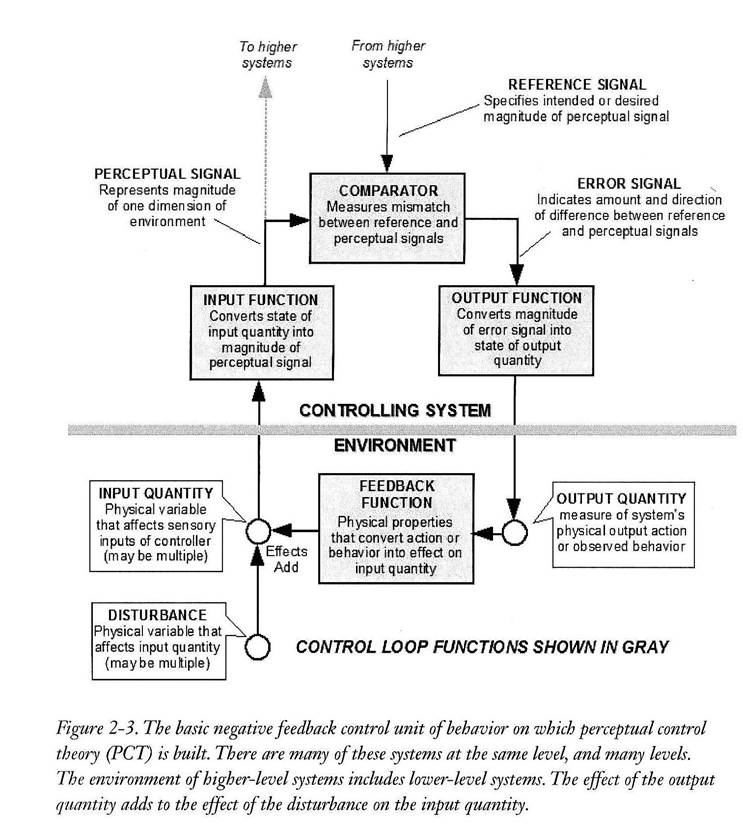
RM: You betcha! (I lived in Minnesota for 11 years, don’cha know). The purpose of the behavior (the controlled variable) is to maintain the level of tension on the patellar ligament. The tap is a disturbance that increases that tension, creating a sudden, large error that drives the corrective action – contraction of the quadriceps muscle. The result is the “kick” that reduces the tension of the ligament. But since the tap-produced tension is already gone (since the tap is over) the “kick” is too late. Under normal circumstances the disturbances to the tension on the patellar ligament don’t come and go as abruptly as they do with the tap. So there is no “kick” as the tension on the tendon is disturbed by things like changes in the terrain one is walking one. So the variations in the contraction of the quadriceps perfectly compensate for these disturbances, maintaining the reference tension on the ligament and keeping you walking upright and balanced rather than constantly stumbling and falling.
FN: Or does a reflex like that qualify as behavior?
RM: You betcha. The patellar reflex (like all reflexes) is a control system. The apparent stimulus-response nature of the reflex comes from using abrupt disturbances to the controlled variable (in this case the tension on the ligament); the disturbances appear to be a stimulus that causes the “kick” behavior. Indeed, it was the use of abrupt disturbances (stimuli) in psychological research that led to the idea that behavior is not purposeful but, rather, caused by stimuli. What was being ignored (or went unseen) was the controlled variable component of the behavior. So the goal of psychological research became finding the stimuli that cause behavior where “behavior” referred only to what we would called the output component of the control loop.
RM: So it’s the abruptness of the disturbances that gives control systems like the patellar reflex the appearance of being caused output. This is all discussed in a typically wonderful paper by Powers called “A bucket of beans”, reprinted in LCS II.
Best
Rick
I happen to agree that most behavior (i.e., the activity of the organism) is purposeful; I’m just not sure that includes reflex reactions.
Fred
From: Richard Marken [mailto:rsmarken@gmail.com]
Sent: Wednesday, June 07, 2017 1:30 PM
To: csgnet@lists.illinois.edu
Subject: Re: William T. Powers is dead - long live William T. Powers
[From Rick Marken (2017.06.07.1030)]
On Tue, Jun 6, 2017 at 1:48 AM, Bill Leach wrleach@cableone.net wrote:
Lord forgive me, I should NOT post on this but…
[also for some reason this reply did not open with csgnet in the ‘To:’ field. I added it so I hope this does not double post to the net]
BL: I’m sorry Boris, but behavior IS controlled,
RM: Behavior can be controlled, in the sense that outputs can be made to take on preselected values by appropriately disturbing a variable that is being kept under control by that output. But my point in this discussion is that what we call “behavior” IS control, which is really just a more technical way of saying that “behavior is purposeful”.
Best
Rick
it is exactly what the control system alters to achieve a control of perception. A control system, engineered or otherwise does not actually ‘control the perception.’ With respect to the physical world and perceptions related to that world is change it’s output in an attempt to achieve new perceptual input that more closely match the desired condition for those perceptions.
It is precisely because the biological control system can not directly control the perception that a reorganizing system is necessary. A problem that was also recognized by the engineering community at least as early as the 1950’s… that is the problem of the disturbance for which the system as presently configured does not have any output that can counter the this (not planned for in the case of engineered systems) disturbance. It was recognized as a problem for response critical systems and for remote systems. In the case for critical systems the rapid failure rate precluded engineering and implementing a correction. For remote system the problem became quite obvious with control systems deployed in outer space.
To suggest that Bill Powers was not well aware of this problem is absurd! It has been way too many years for me now so I don’t remember my discussions with Bill about these sorts of issues other than remembering how his thoughts on reorganization were elegant indeed. Brilliant thinkers like Bill Powers and Richard Feynman are sadly all too rare in human society.
B:CP is Behavior is the Control of Perception. This is the overall goal of the system. That is most certainly a beautiful statement and indeed a proper way to describe the whole system. However the fact is that the system can only ultimately control the ‘actuators’ or outputs. This is true for the particular control system as well as for subunits and even individual control loops.
Outputs or behavior is controlled with the intent to achieve control of perceptions. One view is looking at the goal or why the system works as it does (a very important concept in behavioral science especially when trying to point out what is wrong with all of the other approaches) of the system, the other is a view of what the system is actually doing. My claim is that neither view is wrong.
Obviously I am in no position to speak for Rick but, since Rick is (or at least was a very serious researcher into PCT with a strong focus on producing systems the accurately produce the same results as human systems including quality of control) it is to me no surprise that his focus would be on what the system is actually doing to achieve the goal of controlling a perception. While I don’t remember the specifics of any of the conversations that I actually had with Rick so many years ago, I will state that in all of the work of Rick’s that I have read I have never seen anything that would suggest that Rick thinks that the purpose of behavior is NOT to control perception.
Best,
Bill
On 05/25/2017 02:54 PM, Boris Hartman wrote:
From: Richard Marken [mailto:rsmarken@gmail.com]
Sent: Wednesday, May 24, 2017 9:54 PM
To: csgnet@lists.illinois.edu
Subject: Re: William T. Powers is dead - long live William T. Powers
[From Rick Marken (2017.05.24. 1250)]
Lloyd Klinedinst (2017.05.24 14:14 CDT)–
from the official PCT website:
William T. Powers, the engineer/psychologist who developed Perceptual Control Theory (PCT) passed away on May 24, 2013 at the age of 86. He will be laid to rest next to his wife, Mary, in a cemetery overlooking the city of Durango, CO. His work will continue, pursued by those who came to know Powers and PCT. His theory will someday receive the recognition it deserves, and so will he.
RM: Thanks for pointing out that today is the anniversary of Bill’s passing. Indeed, it’s the fourth anniversary. I am sure that Bill’s insights (first and foremost being that behavior is control)
HB : I’m wondering Rick, when you’ll stop bullshitting with »Behavior is control« without any evidence. Your RCT control loop with central point that »Behavior is controlled« which produces some »Controlled Perceptual Variable« has nothing to do with Bills’ theory and diagrams (LCS III) where it’s obvious that »Perception is controlled«.
And to make a statement on his day of death that central point of PCT is »Behavior is control« instead of »Perception is controlled« is as I’m concerned a crime.
Let us remember how beauty of PCT function in real words and diagram :
Bill P :
Our only view of the real world is our view of the neural signals that represent it inside our own brains. When we act to make a perception change to our more desireble state – when we make the perrception of the glass change from »on the table« to »near the mouth« - we have no direct knowledge of what we are doing to the reality that is the origin of our neural signal; we know only the final result, how the result looks, feels, smells, sounds, tastes, and so forth…¦It means that we produce actions that alter the world of perception…
HB : Did you citate any of his statements to honor memaory of great inventor ?
Do you see any difference Rick between you rude and rough »control of behavior« with »perceptual control« poetry ? I think it’s right that we remember that Bill was a founder of a new original theory which fundaments are »Control of Perception«.
Who are you Rick and why should anyone beleive you ? Except that all maybe is about friendship. And you play on friends feelings. Others tolerate and listen to you because you are friends. And this should be some kind of science ?
I understand that you have no evidences for your statements as many others except maybe »common sense« as Fred. I like Freds’ honest understanding that he doesn’t need PCT to understand with »common sence« that »behavior is control«. It’s probably the same for Carver and Scheier, Vancouver and you. So you could admitt it too. Then we would know that you don’t understand PCT and you don’t need it to understand how and why people behave.
RM ….and theory (that, therefore, behavior can only be expllained as the control of perceptual input) will someday receive the recognition they deserve; I just wish it would be someday sooner rather than later.
HB : Behavior is not control so it can’t control input, it can’ control anything outside. I’ll citate again great master of »perception«.
Bill P (B:CP):
CONTROL : Achievement and maintenance of a preselected state in the controlling system, through actions on the environment that also cancel the effects of disturbances.
HB : Behavior is consequence of control and it is means by which people control perception inside organism or in the controlling system. Behavior is just support for inside control. It’s not main mechanism of control ouside the system. It’s about control in the controlling system. So I hope that people will recognize soon enough that RCT is not PCT. You’ve misleaded many great people here.
I’m sure that PCT will be once leading theory when younger generation will accept the fact of »Perceptual control« and not »Behavior is control«. It’s about how organisms control inside not outside.
Best,
Boris
Best regards
Rick
–
Richard S. Marken
"Perfection is achieved not when you have nothing more to add, but when you
have nothing left to take away.�
–Antoine de Saint-Exupery
–
Richard S. Marken
"Perfection is achieved not when you have nothing more to add, but when you
have nothing left to take away.�
–Antoine de Saint-Exupery
–
Richard S. Marken
"Perfection is achieved not when you have nothing more to add, but when you
have nothing left to take away.�
–Antoine de Saint-Exupery