Hi Eva,
It seems that you are learning very fast. Amazing. I wish you luck with full understanding of PCT.
Regards,
Boris
···
From: Hullu, Eva de eva.dehullu@ou.nl
Sent: Friday, January 25, 2019 2:35 PM
To: boris.hartman@masicom.net
Cc: csgnet@lists.illinois.edu
Subject: RE: Have your cake and eat it: understanding reorganization
[Eva de Hullu 2019.01.25.14.33]
Dear all,
Thank you all for your additions, comments, suggestions and compliments. I will need some time to process and integrate these ideas. Do some science, in the words of Martin J
So far, from the comments of Warren, I get the hunch that the resolution of conflict through new insight/a new combination of perceptions that I see in MOL – having my cake and eat it – might not actually represent reorganization. In this example, no new control systems are needed, parameters of input and output functions don’t have to shift. Just the content, values of these functions change. In MOL literature (books by Carey and Mansell) however, this process is labeled as reorganization. So if this is not reorganization, what is it?
-
If I cut off a main branch of a tree and the tree grows a new branch so that it doesn’t fall (balance is restored).
-
If I learn the Russian alphabet, I develop new references for symbols that were previously unknown to me.
-
If I was conflicted about eating cake or not, and after having a good look at the conflict, decide that it’s okay to want to eat the cake and keep it too, feel no longer conflicted.
-
If a client in therapy realizes for the first time that she can see herself as both vulnerable and strong.
-
If a child learns to ride the bike and is finally able to control keeping the bike stable.
So does reorganization mean that new control systems are added in the hierarchy or new connections are made (as in Ashby’s example of the homeostatic system that made a new wiring after another was cut)? Should the resolution of conflict through awareness that does not involve new control systems (new skills) be called something else? Am I missing something important?
I’ll also ask the MOL mailinglist for input on this subject later, as soon as I get some grip on all the new ideas.
Other aspects that I need to consider:
-
WM and MT: The time scale of reorganization related to the level.
-
MT: What do Seth and Friston (2016) have to say about reorganization.
-
MT: How could new levels be created between the control level as top level and other levels?
-
MT: Q1 How could the output function also transmit an error function to the input in the same level? [I have no idea, my problem is to understand where the error travels to, and how].
-
MT: Q2 How would perception of control [not a state of the environment] occur? What would control perceptions [references] look like?
-
WM: How are intrinsic control systems involved in the model I propose (check dissociation chapter).
-
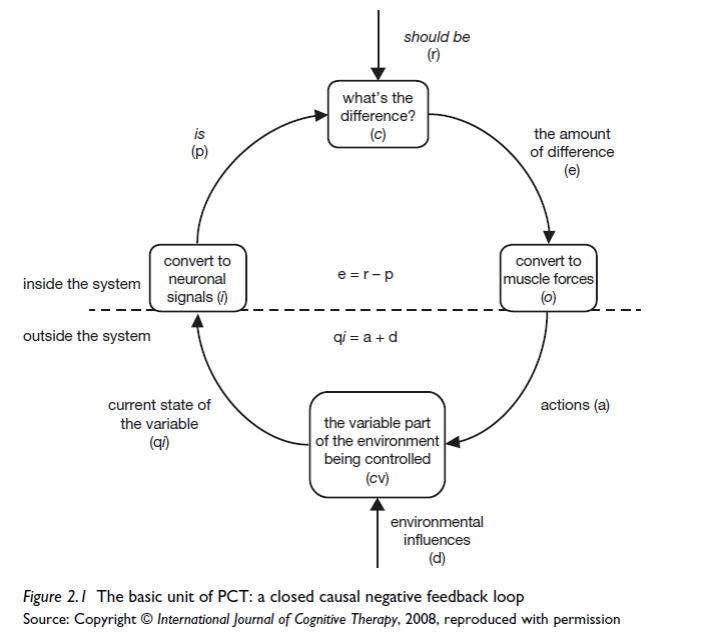
HB: The control loop I used was derived from the picture below, in Carey, Mansell & Tai (2015). I wasn’t aware that there’s no concensus about the location of the controlled variable in the environment. I noticed that in building the PCT hierarchy (also depicted in the same book), it’s easy to leave the CV out. The way I understand it actually, we control our perceptions, which are in fact internal representations of the environmont and thus inside the organism. In the hierarchy, the external world is only connected to the lowest level of the perceptual hierarchy, the intensity level, through our senses. The rest is internal, build up from combinations of perceptions above that level.
-
HB: Is B:CP (2005) the same as the 1973 book or an update? I found a PDF of the 1973 book and can’t find the diagram you speak of. I’ll study the diagrams from and your ideas about that and see if I get it.
Kind regards,
Eva
Carey, T. A., Mansell, W., & Tai, S. J. (2015). Principles-Based Counselling and Psychotherapy - A Method of Levels approach.
Carey, T. A. (2008b). Perceptual control theory and the Method of Levels: Further contributions to a transdiagnostic perspective. International Journal of Cognitive Therapy, 1(3), 237–255.
From: “Boris Hartman” csgnet@lists.illinois.edu
Sent: Friday, January 25, 2019 10:03 AM
To: csgnet@lists.illinois.edu
Subject: RE: Have your cake and eat it: understanding reorganization
Hi Eva and Warren,
Sorry to jump in….
From: “Hullu, Eva de” (eva.dehullu@ou.nl via csgnet Mailing List) csgnet@lists.illinois.edu
Sent: Thursday, January 24, 2019 9:25 PM
To: Warren Mansell wmansell@gmail.com; fwnickols@gmail.com
Cc: csgnet@lists.illinois.edu
Subject: RE: Have your cake and eat it: understanding reorganization
Hi Warren,
I find that drawing diagrams helps in understanding what I’m trying to get across. In explaining PCT to my colleagues I found it difficult to explain the reorganization system. It was the messy part, while explaining control and the role of conflict were fairly easy. So I hope this discussion helps me find a diagram that could be part of the bigger presentation (in which audio would be a part, sounds like fun).
HB : Certainly. Reorganization is difficult to explain because it does not have scientific ground. It’s just Bills “huntch” upon some other authors that organisms could function in that way :
Bill P :
Reorganization is a blanket term that means changing the way the nervous system is internally connected.
The reorganization system doesn’t stop altering behavioral organization when something useful, reasonable, wise, or socially responsible is learned. It stops when intrinsic error goes to zero.
The concept of error-driven reorganization is a distinct departure from traditional notions of the causes of learning.
The reorganization idea is essentially the reversal image of the idea of reinforcement. Under the reorganization concept behavior continually changes as long there is intrinsic error. When an effect of behavior is to reduce intrinsic error, the next change in organization is delayed, so that behavior that happened to reduce intrinsic error persists a little longer. When the behavioral organization is found that reduces intrinsic error to zero (or whatever the required lower threshold is), the behavioral organization that then exists simply continues to operate unmodified.
So under reinforcement theory, a reinforcement effects of behavior has a positive effect on producing the same behavior, while under reorganization theory, a beneficial effects of behavior reduces the changes that the organization producing that behavior will be altered by further reorganization.
Bill P (B:CP) :
My objective in the remainder of this chapter is to develop a theory of reorganization: only this kind of theory can account for the existence of an adult’s hierarchy of control systems.
The concepts however, can be extended beyond my application of them. Nearly everyone who has worked on self-organizing systems has used principles like mine; I am merely adapting what others have done to a specific model.
HB : An important point is that diagram on p. 191 (B:CP, 2005) and problem about “reorganization” originated in Ashby’s idea of double feed-back. In diagram on p. 191, it can be seen clearly in environmental disturbances affecting “control hierarchy” and “Intrinsic variables” which are in Ashby’s theory called “essential variables”.
Bill P :
I took this idea, incidentally, from the cyberneticist W. Ross Ashby because I thought he was right, though I couldn’t prove it.
Bill P (B:CP) :
My model is direct extension of Ashby’s concept of “ultrastability”, the property intended be demonstrated by this uniselector-equipped homeostat. Ultrastability exists when a system is capable not only of feedback control of behavior-affected perception, but of altering the properties of the control system, including how they perceive and act, as means of satisfying the highest requirements of all survival.
Bill P :
Human reorganization capabilities are demonstrated by the so-called plasticity of the nervous system.
HB : It seems that some points in Bills’ theory about reorganizing of nervous system originated also from Maturana. Plasticity of nervous system in widely used in his book “Tree of knowledge”.
HB : I think that term reorganization quite good describes what is generally happening organism and in nervous system (hierarchy), and how learning take place, but it needs scientific support. It can’t stay “blanket term”. So I think as I wrote many times before that serious scientific study and project is needed to finish diagram on p.191 (B:CP, 2005).
Regards,
Boris
WM: Certainly Bill used overall error across perceptual control systems as one possible intrinsic variable that is minimised through reorganisation. Personally I feel that this is more relevant to an infant than an adult human. Accounts of tolerating huge ‘intrinsic’ hardship - such as Frankl’s traumatisation, appear to be transcended by maintaining control of one’s (existential) (higher level) principles rather than by regaining control per se. However as Frankl was probably an exception, maybe it depends on the individual as to which variable is used to reference the need for reorganisation, and the focus of awareness could dictate this.
EdH: Let me check if I get the right perception. Infants are developing their perceptual system. Their variety in input and output is limited. In that situation, any error would look like overall error (there’s something wrong means all is wrong). In an adult system (not just human,any developed organism) one would expect error to remain specific to the level that is involved (you’re probably able to tell at which level something’s wrong). The diagram expresses an adult control system. If this diagram doesn’t allow specification of the location of error, it’s not right yet.
I look at it this way. Perceptions are nested levels. Say I have error at the level of sensation (L2), and somehow this error will be fed back into the input at L2 (following the orange arrows at page 17). Then, at the top level, this signal will arrive intact, as a L2 perception + error nested in L3 configuration etc. The error is not overall, but contained within the level.
I’m not sure I understand your comment about Frankl. Isn’t it right that reorganization is a very individual process, since the references are very specific to the individual? I think extreme hardship such as Frankl is usually endured by dissociation, but in his case he remained conscious (I think) and reorganized at the highest perceptual level, he chose what was important to him. Through this reorganization he regained control (the top level) (as much control as was possible).
Martin provided some literature on the way error can be transmitted. Thank you, Martin, I’ll look into that!
MT: Your specific question, as to whether the error value can be perceived, is a question to be asked of Nature. The “standard model” of HPCT says “No”. But there is a structural model based on one proposed by Seth and Friston (2016) that I have posted a couple of times to CSGnet in which what is passed up to the “+1” perceptual function is not a set of “zero-level” perceptual values, but the set of “zero-level” reference and error values. Since the “+1” perceptual function can recreate each zero-level perceptual value from the zero-level reference and error, this structure can perform exactly the same as the Powers structure, while allowing extra possibilities such as yours.
WM: Second point, just checking - reorganisation alters the enduring properties of control systems such as the input and output functions but not signals themselves, which are emergent.
EdH: Thank you for clarifying, I paraphrased this incorrectly into random changes to input and output. So it should be random changes to the parameters of input and output functions.
Warren, could it be the case that we are discussing two different systems?
I am looking for a way to visualize what I see happening in a MOL conversation: the emergence of ‘insight’, the resolution of conflict. But now I suddenly doubt if that’s what we call reorganization. There is the reorganization that takes place in a developing system, in which new levels are added to the system and new control systems are integrated (indeed, in my model between the control system and the highest perceptual level). And there’s what happens to the signals in an existing control system when conflict is resolved internally.
Eva
From: Warren Mansell wmansell@gmail.com
Sent: Thursday, January 24, 2019 5:29 PM
To: fwnickols@gmail.com
Cc: Hullu, Eva de eva.dehullu@ou.nl; csgnet@lists.illinois.edu
Subject: Re: Have your cake and eat it: understanding reorganization
Hi Eva,
That looks like a lot of hard work already! Very nice slides especially the diagrams.
Do you plan for an audio to accompany it?
Certainly Bill used overall error across perceptual control systems as one possible intrinsic variable that is minimised through reorganisation. Personally I feel that this is more relevant to an infant than an adult human. Accounts of tolerating huge ‘intrinsic’ hardship - such as Frankl’s traumatisation, appear to be transcended by maintaining control of one’s (existential) (higher level) principles rather than by regaining control per se. However as Frankl was probably an exception, maybe it depends on the individual as to which variable is used to reference the need for reorganisation, and the focus of awareness could dictate this.
Second point, just checking - reorganisation alters the enduring properties of control systems such as the input and output functions but not signals themselves, which are emergent.
Hope that proves helpful to the discussion,
Warren
Qqq
On 24 Jan 2019, at 15:31, Fred Nickols (fwnickols@gmail.com via csgnet Mailing List) csgnet@lists.illinois.edu wrote:
Fred Nickols (2019.01.24.1029 ET)
Eva:
Bravo! Nice piece of work. Welcome to the club. I especially like your notion about control being at the top of the hierarchy. Looking forward to more from you.
On Thu, Jan 24, 2019 at 10:21 AM “Hullu, Eva de” csgnet@lists.illinois.edu wrote:
Dear all,
In getting a grip on PCT, I find the most difficult part is visualizing how reorganization works. As I understand so far, this is a concept that’s still very much under construction in the theory. Which also means that there’s room for theory development J
In my thinking process, I’ve prepared a document with diagrams and ideas about reorganization, in which I took Powers’ diagram as represented in Marken & Carey (2015) as a starting point but ultimately ended up with the sense that the reorganization diagram should be simpler, not more complex.
I’d really appreciate your thoughts and comments, either in this mailing list or as comments on the slides.
Have your cake and eat it: https://docs.google.com/presentation/d/1N_hxZ-0AWUcEO_QOQ47HCyqtJVq0WpViaDjpaIlKF-s/edit?usp=sharing
Kind regards,
Eva
Marken, R. S., & Carey, T. A. (2015). Understanding the Change Process Involved in Solving Psychological Problems: A Model-based Approach to Understanding How Psychotherapy Works. Clin Psychol Psychother, 22(6), 580–590. https://doi.org/10.1002/cpp.1919
Deze e-mail is uitsluitend bestemd voor de geadresseerde(n). Verstrekking aan en gebruik door anderen is niet toegestaan. Open Universiteit sluit iedere aansprakelijkheid uit die voortvloeit uit elektronische verzending. Aan de inhoud van deze e-mail en/of eventueel toegevoegde bijlagen kunnen geen rechten worden ontleend.
This e-mail is intended exclusively for the addressee(s), and may not be passed on to, or made available for use by any person other than the addressee(s). Open Universiteit rules out any and every liability resulting from any electronic transmission. No rights may be derived from the contents of this message.
–
Fred Nickols
Chief Toolmaker
Distance Consulting LLC
“Assistance at A Distance”
www.nickols.us
Deze e-mail is uitsluitend bestemd voor de geadresseerde(n). Verstrekking aan en gebruik door anderen is niet toegestaan. Open Universiteit sluit iedere aansprakelijkheid uit die voortvloeit uit elektronische verzending. Aan de inhoud van deze e-mail en/of eventueel toegevoegde bijlagen kunnen geen rechten worden ontleend.
This e-mail is intended exclusively for the addressee(s), and may not be passed on to, or made available for use by any person other than the addressee(s). Open Universiteit rules out any and every liability resulting from any electronic transmission. No rights may be derived from the contents of this message.
Deze e-mail is uitsluitend bestemd voor de geadresseerde(n). Verstrekking aan en gebruik door anderen is niet toegestaan. Open Universiteit sluit iedere aansprakelijkheid uit die voortvloeit uit elektronische verzending. Aan de inhoud van deze e-mail en/of eventueel toegevoegde bijlagen kunnen geen rechten worden ontleend.
This e-mail is intended exclusively for the addressee(s), and may not be passed on to, or made available for use by any person other than the addressee(s). Open Universiteit rules out any and every liability resulting from any electronic transmission. No rights may be derived from the contents of this message.