Down…
···
From: Bruce Nevin [mailto:bnhpct@gmail.com]
Sent: Wednesday, July 12, 2017 4:06 AM
To: CSG
Subject: Re: p vs q.i.
[Bruce Nevin (2017.07.11.22:00 ET)]
RM: Actually, I said that q.i is not an *environmental *variable. It is certainly a variable – a variable aspect of the environment that is controlled as a perceptual signal (also a variable) in a control system.
Saying “variable aspect of the environment” is what makes it sound like you are saying that q.i is in the environment.
More carefully yet, you might say “It is certainly a variable, a perceptual variable. It is a perception of that which perceptual evidence tells us is a variable aspect of the environment. It is controlled as a perceptual signal (also a variable) in two control systems: as the perceptual variable p in the subject and as the perceptual variable q.i in the experimenter.”
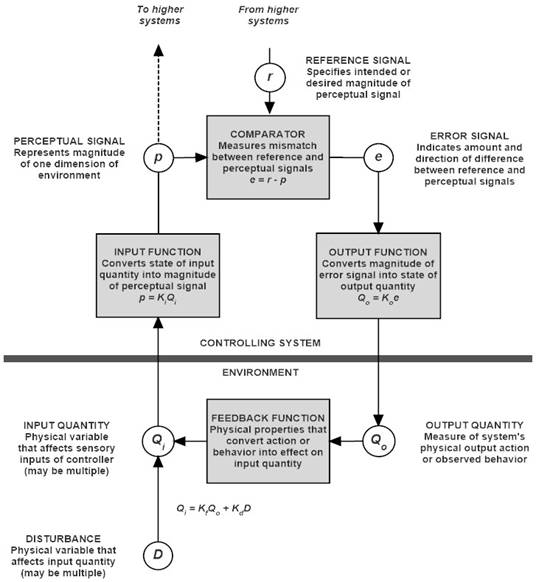
HB : You are contradicting yourself Bruce N. and to PCT model. There is no different perceptual signals in the sense that they are labeled differently (p, q.i.). You said it for yourself which are »lables« that make different perceptual signals (p1 and p2). In PCT Control works in all LCS the same so go and see where q.i. is in the PCT diagram (LCS III).
But if you are not talking about PCT and you are using your own model, then you could maybe suggest changes in PCT model. Â
HB : Well, well things are always complicating as usual when somebody is not listening to Powers couple. Why using your BNCT model if you have perfect PCT model ???
Boris
On Tue, Jul 11, 2017 at 4:02 PM, Richard Marken rsmarken@gmail.com wrote:
[From Rick Marken (2017.07.11.1300)]
Martin Taylor (2017.07.11.13.00) –
RM: The problem, I believe, is that in diagrams such as the one below, it is not made clear that q.i (or Q.i) is actually a function of environmental variables and not an environmental variable itself. That is, p is not a function of q.i; both p and q.i are the same function of environmental variables; q.i is p from the observer’s perspective.
MT: Today’s New Math principle (not new today, though) is that if x = f(v1, v2, …) where v1, v2,… are variables, then by definition of “variable” x is NOT a variable. I don’t know what x is in this New Math, but Rick has been very clear, today and in the past, that whatever it is, it is not a variable.
RM: Actually, I said that q.i is not an environmental variable. It is certainly a variable – a variable aspect of the environment that is controlled as a perceptual signal (also a variable) in a control system.
RM: I know this is a tough concept to get. It’s probably important only for researchers to get it. But it can’t hurt for non-researchers to get it as well.
MT: Why don’t you publish your new “Elements of New Math” book, because New Math certainly incorporates a lot of “tough concepts to get.” An exposition, like Euclid’s “Elements” from first principles, might make life easier for those of use who were brought up with the old-fashioned maths used by the rest of the world.
RM: And you were chiding me for the disturbing “tone” of CSGNet?
Best
Rick
–
Richard S. Marken
"Perfection is achieved not when you have nothing more to add, but when you
have nothing left to take away.�
–Antoine de Saint-Exupery