I seem to recall that feedback functions are considered to be particularly important in the study of collective control. They are even given a special name – ATENFELS? Could someone please give me a quick explanation of the role of feedback functions in collective behavior? Thanks.
Yes, the environmental feedback function is an essential part of every control loop.
Most PCT discussions are concerned only with individual control systems, and the environmental feedback function amounts to no more than recognition merely that a control loop is closed through the environment. It is abstracted to the fact that behavioral output affects sensory input, in parallel to the effects of disturbances on sensory input. In the block diagram in the appendix to B:CP, it is represented by a single “Environment Function” box for the function Ke.
In collective control the fact that this is an environmental function gets more attention. This is necessary, because in collective control each individual controller is in the environment of each of the others.
For any given controller, the influence of the behavioral output is transmitted to perceptual input through a medium or media in the environment. For the production and perception of sounds, the environmental medium is the gasses of the atmosphere, or a combination of atmospheric gasses and solid substances if you’re complaining about the neighbor’s loud music or if the driver behind you is honking her horn. These media, which are themselves perceptible as e.g. objects and gas-filled spaces between objects, define segments in a feedback path between output and input. (Not all are conveniently identified with configuration perceptions, and in many cases words like path and segment are not so literal. The awkward neologisms Atenfel, etc. are attempted general vocabulary for segments in environmental feedback paths.)
In a collective situation, the individual environmental feedback paths cannot coincide entirely, of course, because the endpoints (the output functions and input functions) are uniquely identified with each separate controller. However these paths can intersect. More specifically stated, the environmental feedback paths of two controllers may have one or more segments in common. To make that more concrete, while driving you control your perceptions of the relationship of your car’s left and right fenders to your perceptions of the left and right margins of your traffic lane a certain distance ahead of your (changing) instant location. This is also true of drivers ahead and behind, and in respect to one of those margins it is true of oncoming drivers in the opposing lane, of those in parallel lanes of multi-lane highways, and so on. The roadway itself is perception that you control as a segment of your route (itself a controlled perception), until you turn at an intersection and commence travel on the next segment of your route, but other drivers are traveling on that same roadway, some continuing onward on it, some turning with you, some turning the other way, but for the moment your paths intersect.
This is easy to see for literal paths of travel. The car itself is a ‘segment’ of your environmental feedback path by which your behavioral outputs result in the distance relation between you and your destination being reduced to zero. So is the key (or keyfob) for your car. Someone else in your family might have borrowed your car for their own journey. Someone may have lost your keyfob. You may have received a recall notice for some part or function of your car, means by which officers of the car company control avoidance of legal liability for some failure which (the failure) is also your interest to avoid. The notice arriving in the mail or email is a segment in control by the corporate officers and by the employees who by various environmental feedback paths are directed to control creating and sending the notice. They trust that mail carriers and maintainers of the Internet control successfully, just as you trust that drivers oncoming in the opposing lane are controlling successfully. That trust is itself a collectively controlled perception.
Thanks, Bruce. I asked because I came across the following statement by Warren in one of his papers (I can’t remember which one): “… sophisticated feedback functions to draw users into rabbit holes…”. I found this somewhat puzzling because it sounded to me like Warren was saying that the feedback functions he was discussing (which, as I recall, were the “algorithms” of social media) cause the users to go down rabbit holes. I’m asking you rather than Warren because you seem to be the maven of feedback functions. What do you make of that statement? By the way, I feel like we might have discussed this before but apparently my memory is not surviving the aging process nearly as well as yours.
You’re asking me to interpret or elaborate upon the phrase “… sophisticated feedback functions to draw users into rabbit holes…” taken out of context, except that you think that it has to do with the algorithms employed by Facebook/Meta and the like.
Warren is the world’s leading expert on what he, Warren, intended. I respectfully decline; as I must, to be respectful to you both.
But I’ll indulge my puzzlement.
No need for scare quotes, the algorithms are not metaphorical. And evidence supporting such claims about them has been presented in court, examined in detail by experts in algorithms and in techniques for influencing people’s attention, beliefs, and disbeliefs, resulting in settlement or loss by the corporations, so there does seem to be a there there to which Warren is referring. These computational structures are in users’ environment intervening between what they type and what they see in response on their screens, so it seems difficult to claim that they are not part of the environmental feedback function in such transactions.
Is your difficulty with this because you’re used to the environment function being represented by a single mathematical function Ke in a laboratory setup, and now we’re talking about the complexities of the environment as people ordinarily live in it? That’s a lot of work for Ke to do.
Sorry, I should have been more specific because my question is pretty context independent. I was only curious about the “draw users” part of the statement because it sounds like Warren is saying that feedback functions “draw” --ie. cause – people to do things – like go down rabbit holes. My question should have been “Do you, as an expert in feedback functions, think that feedback functions can cause people to do things?”
I agree that it’s more appropriate to say that algorithms influence (rather than cause) behavior but they can wield that influence only when people are controlling for the variables affected by the algorithms. The people using the systems that provide the desired content are just as responsible for the influence of these algorithms as are the algorithms themselves.
Those computational structures are definitely in the environment of the people using the systems. But I think they are more like disturbance sources than feedback functions. After all, the user’s output (a button click) has no regular, functional relationship to the controlled variable (the content they are presented).
It’s the controlled variable itself (the content presented) that is used by the algorithm to determine what content to present – the content being an independent effect on (a disturbance to) what is displayed (the controlled variable).
Disturbances influence behavior (clicks) just as feedback functions do. To the extent that the disturbances result in the display of content the user wants to see, the user will click less and, thus, spend more time on that content.
No. It looks to me like you guys are the ones having difficulty with it. I’m here to help, if you want it.
While we’re on the subject, could you explain what’s wrong with using a single mathematical function, Ke, to represent the feedback function when “we’re talking about the complexities of the environment as people ordinarily live [and control] in it”? A diagram showing a situation where this is the case – where the feedback function has to be more complex that Ke – would be helpful.
Seriously? You’re controlling to say “Gotcha! Warren, you’re a closet S-R behaviorist!” and you want me to participate? With a patently sarcastic “you, as an expert in feedback functions” which you clearly disbelieve?
Ke is a function in an individual control loop. There is no single Ke in collective control, which is a consequence of control by autonomous controllers in a shared environment and in real situations usually includes control of environmental means to facilitate control or avoid conflict. But Rick, I am under no obligation to convince you that collective control exists, what it is, and how it works.
Hi Rick, I’ve got a simple word for a feedback function that ‘draws people in’. It’s called a ‘trap’.
How could I be controlling for saying something I didn’t say (which I wouldn’t say because I don’t believe it)? But I will cop to being somewhat sarcastic about you being an expert in feedback functions. “Somewhat” because you write rather authoritatively about feedback functions being an important part of understanding collective control phenomena.
There is certainly no single Ke in collective control. But this is a consequence of there being more than a single controller in the collective and each controller has its own Ke’s connecting it to the variables it controls. Being in a shared environment has nothing to do with there being no single Ke in collective control.
And, even better, you don’t need to convince me that collective control exists. I knew it existed way back in 1980 when I suggested some studies of multi-person control to Tom Bourbon (which, of course, he then ran width, resulting in some nice publications and talks). And I described (and modeled) many different examples of collective control in the Social Control chapter of my book “The Study of Living Control Systems”.
Yes, a feedback function can look like a “trap” to an observer with an interest in the output component of the control loop. For example, B. F. Skinner was intereted in the rate at which a rat presses a lever to get “reinforcement” (a food pellet). He found that he could “trap” different rates of pressing by varying the feedback function connecting the rat’s output (lever presses, O) to its input (reinforcements, I),
The feedback relationship in Skiner’s operant situation is I = Ke*O where Ke was the number of presses required to get one reinforement: Ke = I/O. If Ke = 1 then one press produces 1 reinforcement; if Ke = 1/10 then 10 presses are required to produce 1 reinforcement. What Skinner found is that you can “trap” a high frequency of presses by setting Ke to a low value (more presses per reinforcement).
Perhaps you are thinking that this is the way the computer algorithms used in social media “trap” people’s attention; attention is the output that is “trapped” by the algorithms. But for this to work, attention (O) would have to have a functional relationship, via the algorithms, to the material attented to (I). But such a relationship clearly doesn’t exist; you can’t produce social media content by attending to it.
This is why I think the social media algorithms work like sources of disturbance to the content (I) that is produced by clicks (O). The “trap” of attention in this case is not a feedback function (from clicks to content) but, rather, the reference for the kind of content the user wants to attend to (spend time on). In other words, the fault, dear Warren, is not in our algorithms, but in ourselves! Well, it’s actually in both the algorithms and ourselves. The algorithms just make our faults more useful to others.
The algorithms don’t disturb the content. They provide the content. If you were to apply your logic to gun control, then guns should come in Frosties packets. Your last statement is clearly correct and ‘making peoples faults usable to others’ is exactly what is of concern, and the point of my YouTube talk, which was always Bill’s point too - that once you know what a person is controlling for, and it remains consistent, you can apply disturbances to manipulate that person, just like Skinner did in your example. Are you saying that the same doesn’t apply to the capacity for removing disturbances or providing additional resources to manipulate someone (or trap them) when you know their goals? I wonder whether we need to explain and model multiple goals in conflict for this to work; if we presume that some people have reference values that they use conflict to inhibit their pursuit of (like not scrolling all night even though they’d love to) then are we getting somewhere?
The state of the content displayed is presumably the state of the controlled variable (CV). The algorithm provides content that affects the state of the CV independent of the user’s actions that display that content. So the algorithm is a source of disturbance to the CV. It is not part of the feedback function that connects the user’s actions (clicking, pressing keys) to the content . Here’s a little diagram of what’s going on:
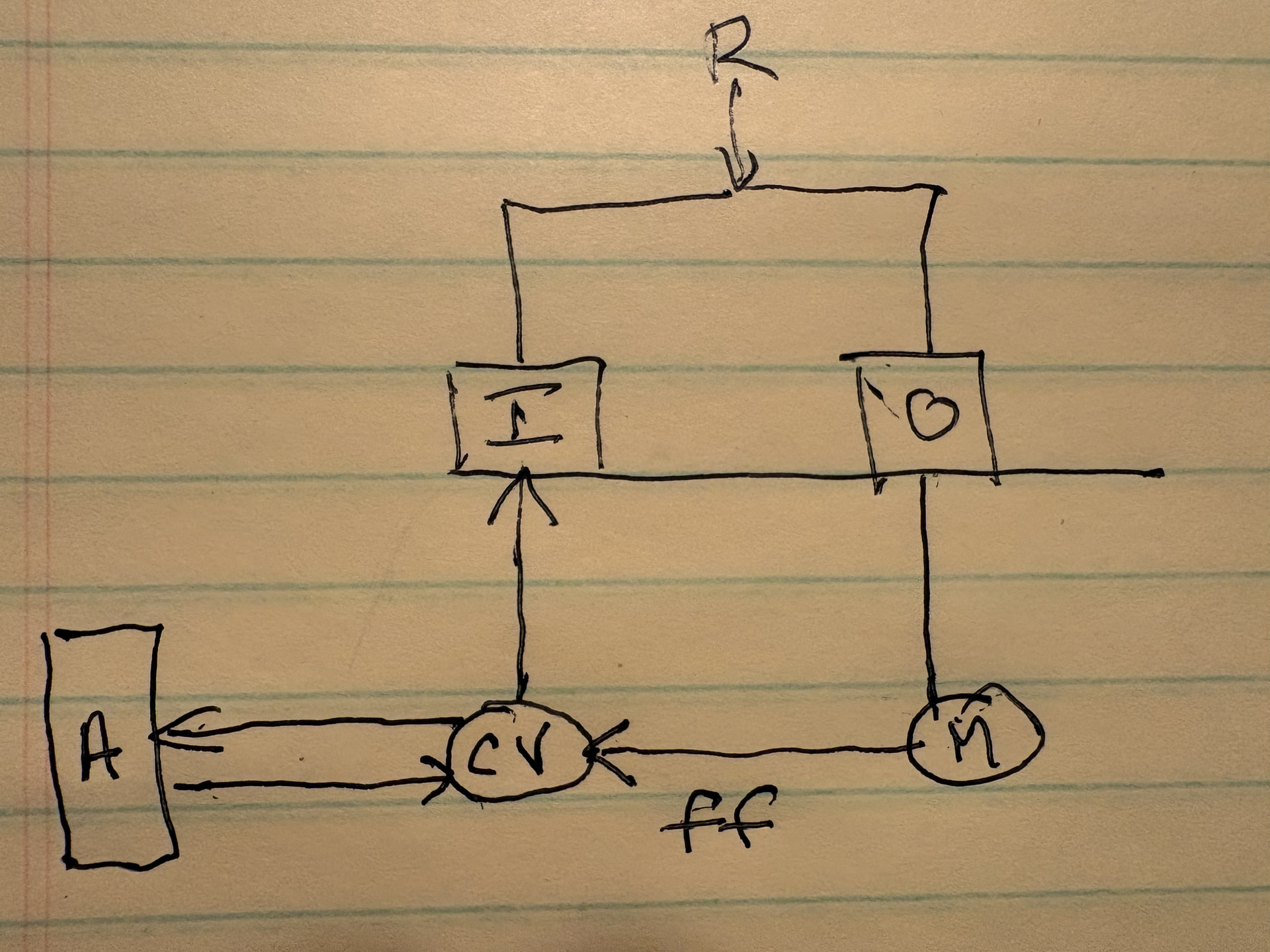
The CV is the content that is provided by the algorithm, A, which is also monitoring how long that content is viewed (the arrow pointing toward A) and uses this information as the basis for providing future content (the arrow pointing toward CV). How long the content is viewed is presumably affected by the user’s action such as a mouse click, M; the closer the content comes to matching the user’s reference, R,the longer the delay until action is taken. When action is taken, new content is presented by the algorithm. The feedback function, ff, is the computer code that switches to new content; but it has no effect on what that content is.
Like Mr. Bennett in Pride and Predjudice, I’m afraid I do not have the pleasure of understanding you.
This statement is extremely confused but I’ll try to untangle it. Yes, once you know what variable an organism is controlling, you can control the means they are using to control it (such as a lever press) by applying disturbances to that variable. But that is not what Skinner did in my example. In the example, Skinner used variations in the feedback function, not disturbances, to control lever presses. That is, he used the method of control (via feedback fuction) that I thought was the one you (incorrectly) attributed to the algorithms of social media in your talk. But here you say that your talk attributed control by disturbance to these algorithms. If so, congratulations on getting it right.
A control system doesn’t “remove” disturbances to a CV; it can only act to counter their effects on the CV. In the case of algorithms, a user counters disturbances – content that is far from the reference – by acting quickly to get the next content delivery from the algorithm.
By the way, if it’s not clear frm the diagram, the output that the algorithm is “trapping” by learning to disturb the CV properly is the time between mouse clicks; the more desireable the content provided by the algorithm after a click, the longer the user will linger on that content before clicking again.
Anyway, I hope you now see that algorithms are not part of the feedback function in social media.
Best, Rick
Hi Rick,
How about thinking of this way… a hammer is a feedback function for the CV of ‘nail embeddedness’ with an RV of ‘nail fully embedded in wood’ or it could be ‘just nail head visible’. I have a choice whether I use a hammer or another tool to get the nail in the wood. I choose the hammer. Similarly, a smartphone user wants to see more kittens. The means to get the CV of ‘kitten experience’ to the RV of ‘constant kittens’ is the feedback function in the environment. The user has a choice whether to look for real kittens, search for kittens on Google, or use a social media platform with an algorithm that automatically sends them kittens. The user chooses the social media platform, but in the process of doing so, loses awareness of various other competing CVs - time, food, water, their own pet cat - and so feels frustrated and annoyed with themselves after scrolling for an hour….
I think this is all achieved without disturbances, just feedback functions that vary in their delivery rate…
The main point of my previous post was that the algorthms of social media are sources of distutrbance rather than feedback functions. I don’t see how this post addresses that but I’ll answer it anyway and then follow with some questions.
A hammer is NOT a feedback function; it IMPLEMENTS one. In this case the feedback function is the relationship between forearm movement (output, O) and change in nailhead position (CV) (I say “contribution to change in the CV” because the state of the CV is aways a result of the combined effect of output and disturbance: CV = O + D.)
A linear approximation to the feedback function implemented by the hammer is CV = k*O. Different tools will have different k values (feedback functions) resulting in different amounts of change in nailhead position (CV) per unit change in forearm position (O). For example, a hammer with a 1 pound head and 12 inch handle might have a k of .1 in the control loop – a 1/10 inch change in nailhead position per change in forearm position.
A different tool, like a handheld scraper, might have a .01 pound head and 9 inch handle resulting a k of ~.001 – a 1/1000 inch change in nailhead position per unit change in forearm position. So if your time to you is worth savin’ – if you have a higher level goal of spending less than the rest of your life hammering in nails – you would “chose” (set a lower level reference for) a hammer.
Feedback functions are only “in” the environment of a control system that is acting (producing outputs) to control aspects of the environment (controlled variables). They are not just sitting out there waiting to be used. If a person is using a smartphone to see kittens then the only feedback function in this situation would be the connection between the person’s finger taps on the phone and the display of kittens. In most smartphones with which I am familiar there is no such connection. To get to the kittens you have to tap on something like Facebook and search for them, in which case the appearance of kittens is the state of a disturbance variable (the variable being the type of content found in the search).
If you could indeed take an action on the social media platform that launched an algorithm that always took you to kittens then the algorithm would indeed be part of the implementation of the feedback function that connects your output to the CV. But then the algorithm wouldn’t be much of an algorithm; more like a GOTO statement.
The same thing happened to me when I was a kid and came home and switched on the TV to Channel 5. I couldn’t get enough of the Popeye and Road Runner cartoons. No algorithms needed.
What is “all this” that was achieved? What were the feedback functions that were involved in these achievements? Were they algorithms?
If there were feedback functions involved in these achievements then there were control systems involved. And controlling – which is what control systems do – always involves BOTH disturbances and feedback functions.
And why are you so keen on feedback functions being the only thing involved in whatever achievements your talking about? Especially since I’ve shown that the algorithms of social media are not feedback functions but, rather, sources of disturbances (“good” disturbances, since the algorithms are trained to “push” the CV into states that correspond to the user’s references).
Hi Rick, I think my issue is the attempt to see a disturbance as an independent force pushing the CV towards the RV, when we know that the algorithms are trained on the users’ preferences. I am used to thinking of disturbances as non-agentic (but I appreciate that a control system can be ‘behind’ a disturbance, but algorithms are designed and trained with a goal in mind, so that jars too as I feel that the diagram needs to include this, as well as the competing goals of the user I mentioned. I get your point though that the algorithm is only enabled at the point a person is actually engaged with their phone to access the platform, and so is not a feedback function. However, algorithms are designed specifically to draw people towards ‘high-click’ content they would otherwise have missed, which also seems different to the TV example. Even TV adverts rarely send you to be able to act upon the advert instantaneously and continuously.
Don’t you agree there are many more layers of complexities we miss by just regarding an algorithm as a disturbance?
But why, then, conclude that the “agentic” algorithm is a feedback function? Feeback functions are non-agentic.
But it does. The algorithm box, A, has arrows going to the CV (sendiing the disturbance content to it) and from the CV (where the algorithm uses information about the time spent on the differrent values of the CV to develop its prediction equation that tells which values to send to the CV as “good disturbances”) .
I don’t think you do. The algorithms are not a feedback functions because they are not in the path that connects the user’s output (click) to the CV (the content presented).
I think it’s exactly the same thing except in the old days they could only work the algorithm on the aggregate audience. The TV algorithm was keeping shows on the air that drew large audiences and getting rid of shows that drew small ones. A partial solution to this (in the US anyway) was the devlopment of public, non-commercial television. I might have grown up watching Sesame Street and become real smart but instead wasted my early years watching cartoons, which probably explains a lot;-)
Yes, that was a nice thing. It took me a long time to get my parents to buu me a Mickey Mouse watch (which I promply lost interest in).
No, I don’t. I think it’s most important to correctly map the model to the phenomenon. But maybe you could tell me what complexities are explained by regarding the algorithms as feedback functions. That would definitely help me understand why you seem to be so keen on seeing things as feedback functions.
The algorithm is not a feedback function. You’ve convinced me. And l like the diagram. It is not complete, in that is does not show the agents designing the algorithm but it is accurate, now you have explained it.
I guess it would help me to hear from you what you think the implications are with regarding the algorithms as disturbances rather than feedback functions. It still seems to me that it is an example where if you know a user’s CV, RV and their means of control, and these stay fixed for a while, then you can control that person’s behaviour via how you apply disturbances to that person, as Powers and yourself have claimed (e.g. if a car is following you then you can make it go where you want), and as I claim in my ‘Reversing Coercion’ talk. An algorithm can adjust itself dynamically to learn the RVs and CVs of the user…
Warren, a feedback path (or a segment of a feedback path) is not a feedback function.
As Rick says, the feedback function is a mathematical expression of the relationship between change in the output and change in the controlled perception. To quantify that relationship all you need is the endpoint variables, Qo and Qi.
Whether the setting of a nail is ‘implemented’ by a hammer, a rock, a battering ram, or the bumper of a car, the physical properties of that environmental means facilitating control, including but not limited to weight, could be quantified and taken into account to explain the relationship between Qo and Qi, but to determine the environmental feedback function (the relationship between Qo and Qi) no such investigation is required. No investigation of the physical properties of the environmental feedback path which implements that relationship is needed to determine a value by which to multiply the value of Qo in order to calculate the value of Qi. All you need is those two quantities to derive the mathematical relationship between them, which is the feedback function.
It becomes important to investigate environmental feedback paths, and segments of environmental feedback paths, when more than one controller occupying that environment controls his/her/its perceptions of these means of facilitating or ‘implementing’ control. Perceptions of an environmental feedback path (or path segment) come under control because if their condition is disturbed from their reference value it is more difficult or even impossible for those controllers to employ them to ‘implement’ feedback functions for control of other perceptions that matter to them. The socially most important forms of collective control follow from that.
Your claim still holds: the algorithm is controlling the user’s behavior (time spent with certain content displayed) by presenting what it has found to be the kind of content (state of a CV) the user wants to see. But it’s definitely not doing what I would call “coercion”; the user isn’t being forced to spend more time on certain content. It is manipulation of behavior via disturbance (as in the rubber band demo) and it can create problems for the user (such as the internal conflicts you’ve mentoned in earlier posts). But, as you know, the way to solve such conflicts is via reorganization of the systems in the user that are creating the conflict. But regulation of the systems (the algorithms) doing the controlling might help as well, to the extent that you want to have people spend less time viewing the things they like to view.