Question About Feedback Functions

It depends on what you mean by “noise”. If you mean the perception, then yes, I would say "no’, the tree makes no noise. If you mean the randomly varying pressure variations in the air, then no, I would say “yes”, the tree makes a noise.

By the way, the distinction between feedback path and feedback function is absurd because your defintion of feedback path leaves out an important component of that path: the perceptual function that defines the controlled variable. My What is Size? demo shows that the same feedback path (your definition) can result in drastically different feedback functions depending on what perception you control.

The feedback path (as you define it) has little to do with understanding the controlling done by individuals or groups of individuals. Moreover, it has nothing to do with the “challenge” Luk had for me, which was to show that PCT could handle controlling that was being done while another control system was disturbing the feedback function (remember A and B). Luk’s challege had nothing to do with feedback paths and I developed my little Controlling w/ Variable Feedback Function demo to show that PCT could easily explain A’s controlling (doing the tracking) while B is interfering with the feedback function.

You guys really should try PCT, but maybe you have and didn’t really care for it.

Yes, and the each of the n customers talking to the n agents is connected to the agent by a separate feedback path (and function).

I give;-)

The variable that is collectively controlled is the availability and usability of the customer service facility. Not the individual telephone connections to that service (a perceptual variable which is collectively controlled by a different collectivity).

That’s putting theory first and substituting a variable that fits the theory in place of the variable which was presented. You keep changing the terms to something that fits the asocial model in which society is an incidental byproduct of independent agents each doing their separate controlling.

To apply a familiar illustration, what the crowds demo demonstrates is that the rings and arcs are not collectively controlled, they are just a collective byproduct of individual control. But (to pick one aspect of the variable “Delta customer service facility”) the perception variously nameable “a job, employment, gainful employ, being an employee, having employees”, etc., is not an emergent by product of individuals each in their isolated perceptual universe. Many people have the job (gainful employ, etc.) of maintaining the perception that Delta’s customer service facility is available and usable to anyone who calls. To follow just one line of contribution to collective control, callers who are unable to ‘get through’ to an agent and get their customer needs serviced often complain, sometimes in ways that disturb an agent or manager’s perception of their gainful employ continuing, which is an effective contribution to collective control.

Collective control is an area of research in which PCT can make vitally important contributions. I offer here Jack Smith’s designation of a collectively controlled perceptual variable at the end of his opening statement in a congressional hearing yesterday:

I remain confident, however, that the rule of law will endure because so many continue to uphold it faithfully each day. Throughout our legal system, public servants have remained faithful to their oaths despite extraordinary pressure to do otherwise. Their example demonstrates that while fear may be contagious, courage is as well.

You fancy yourself Prince Charming with the glass slipper in search of Cinderella but surrounded by ugly sisters. You seem more like Procrustes with your iron bed beside the road to Athens. Ah yes, Athens. Another collectively controlled perception.

Yes, the participants in collective control may perceive and control different aspects of the collectively controlled variable. Your “What is Size?” demo illustrates how control of one aspect disturbs control of another. The different definitions of “size” are different aspects of one variable (the visual configuration). If the program is extended to allow one controller for each definition of “size”, then the conflict yields a collectively controlled result. If each aspect is put under control of plural agents, then you have a more complex conflict but still a collectively controlled result.

But that is all still in the realm of emergent results, like the Crowd demo. The configuration whose “size” is manipulated is not itself used as means for controlling some other variable V. It is not part of the environmental feedback path through which additional agents’ outputs controlling V must pass in order for them to control it. The environmental feedback link may be on the output side (outputs transformed to environmental influences being transmitted to influence the aspect of the environment perceived as V) or it may be on the input side (variations in the state of that aspect of the environment being transformed to environmental influences being transmitted to influence the perceptual input organs of the controllers).

Its fine if you don’t want to bother with the complexities of social life and just model autistic control systems.

You described an example of “collective control” where customers queued up to talk with agents. How was I to know that the controlled variable was “availability and usability of the customer service facility”?

I was putting phenomena first and trying to give a possible explanation in terms of a model relevant to those phenomena. Perhaps it looked like I was putting theory first and changing terms to fit an asocial model because I failed to see that your example of customers calling agents was not given to see how I would explain the behavior of the customers and agents but, rather, to see how I would explain the behavior of the IT staff at the customer service agency.

Ah, this is helpful. So “collective control” only applies when a collective of people (organisms?) is producing a particular result intentionally. So Bill’s model of crowd behavior and my model of phonemic drift are not models of “collective control” because the results produced by the collective – such as patterns made by the individuals in the crowdor the democraphic differences in pronunciation – are side effects of the controlling done by individuals in the collective.

So what you need is a model, such as that described in the “Modeling Two-Person Cooperation” section of the Social Control chapter of The Study of Living Control Systems. In that section I describe some of Tom Bourbon’s models of a collective of two people producing a result that could not have been produced by either person alone.

I wouldn’t say “ugly”; just not to my taste;-)

I’m not interested in cutting anyone to fit; that is, I’m not interested in controlling people. I’m just telling people what I think is right. I don’t expect you (or anyone else) to agree with me. I’m just happy when nature agrees with me, as it so often does when I use PCT models to predict what nature will do.

This seems quite pivotal…having even less familiarity with Kent’s and Bruce’s and Martin’s work than with “OG” PCT… it seems they are very interested in members in a collective not just cooperating, but working to maintain a resource out there in the world so that anyone else can come and use that resource…and in the role of such resources in the ‘transmission’ of what can be taken as ‘shared references’ over time and space.

For example, I can, as a random member of the public control for the reference “walk the Te Mata Peak track”, only because people have been working to maintain that track for decades, and other people have been walking the track for decades and talking about “walking the Te Mata Peak track” - the walkers and the maintainers and the talkers all keep the possible reference in the Zeitgeist for me to pick up.

Bruce, is it fair to say that coming to see collective control “everywhere” requires seeing all this maintenance work tacitly involved in whatever we individually want to do, and come to want to do?

[PS apologies for previous deleted thread - still getting used to the functionality here.]

Hi Rick,

Let’s strip away the analogies and return strictly to the mathematical formulation.

In post #105, you presented a tracking demonstration with a time-varying feedback coefficient and concluded that PCT handles variable feedback functions without difficulty.

That demonstration completely dodges the actual phenomenon under discussion:

**1. Parameter Variation vs. Gain Collapse:**

In your demonstration, the feedback coefficient $FB(t)$ fluctuates, but it remains strictly positive ($FB > 0$). In any high-gain negative feedback system (as analyzed by Bode, and formalized in PCT), loop gain trivially desensitizes the system to moderate, non-zero plant gain variations. That is elementary control theory and was never in dispute.

The phenomenon demonstrated in post #93 is not a non-zero parameter fluctuation. It is **environmental gain collapse**:

$$\frac{\partial p_A}{\partial q_{oA}} \to 0$$

caused by substrate saturation ($S \ge C_{max}$). In your tracking program, you did not evaluate the behavior of the loop when $FB$ is driven to zero in the presence of persistent error.

**2. Your Formal Concession in Post #104:**

In post #104, you wrote:

> *“p_A = q_oA * M where M= f(q.o_B)”*

The moment you define the environmental transfer multiplier as $M = f(q_{oB})$, you formally concede the argument. You have explicitly stated that the environmental transfer function is not an invariant scalar property ($k_e$) of an isolated loop, but a state-dependent function coupled to the physical output of another controller. That is the exact definition of an environmental substrate with finite state and capacity.

**3. The Unanswered Mathematical Consequence:**

Consider your formulation $p_A = q_{oA} \cdot M$ where Agent B drives $M \to 0$:

* The controller observes error: $e_A = r_A - p_A \neq 0$.

* The output integrates error: $\frac{dq_{oA}}{dt} = G \cdot e_A$.

* Because $M = 0$, increasing $q_{oA}$ produces zero change in $p_A$ ($\frac{\partial p_A}{\partial q_{oA}} = 0$).

Under standard PCT mathematics, this produces undeniable **integrator windup**: $q_{oA}$ drives monotonically to its physical bound ($\text{Output}_{max}$) while control authority is completely decoupled.

The question remains unchanged:

Can a stateless plant with fixed scalar gain and additive disturbance ($p = k_e \cdot q_o + d$) produce this gain collapse and decoupled windup without explicitly modeling the capacity and state of the shared environmental pathway?

If yes, please provide the differential equations showing how an additive disturbance $d$ drives $\frac{\partial p}{\partial q_o}$ to zero without altering $k_e$.

If no, then the physical state and throughput limits of the environmental substrate must be explicitly repre

sented in the model.

Best,

Luk

Because that’s what I said.

This illustrates a familiar process in which you denied something because it doesn’t fit the frame of an individual controlling with no collective influence on the controlled variable, and later not even remembering the thing that you had denied or that you had denied it. Poof! Magic.

The collectively controlled variables in that person’s life are not the only perceptual variables that they’re controlling. Some of them are not subject to collective control influences. At the conference, I’ll be challenging people to identify some.

Yes, though of course “intentionally” does not entail “consciously”.

In one case, the influence on the variable is an accidental byproduct of controlling a different variable or variables, and the variable perceived by the observer (Clark McPhail) is not perceived by the participants in the collectivity (individuals in the crowd), or if they do perceive an arc or ring forming it is only incidentally or it might become significant if they maneuver to get a better view or closer to the point of interest, something which the CROWD demo does not model. Individuals outside the collectivity may perceive the collective result and control their perception for their individual purposes: a photographer seeing a good composition, a terrorist seeing a great place to lob a bomb, Clark McPhail seeing the object of a sociological study.

In the other case, the influence on the variable is purposeful for each participant in the collectivity producing it. I have identified one class, in which the variable is controlled because it facilitates control of diverse variables by those individuals, being created and maintained as such as part of our social environment. I imagine you appreciated having a job when you had the obligation of supporting a family (“family” being another collectively controlled variable). I imagine you appreciate having retirement income and Medicare now. I imagine that you would act to oppose disturbances to these, and I know that many others would, collectively.

No, it demostrates what I said it demonstrates: that the same feedback path (your definition) can result in drastically different feedback functions depending on what perception you control. If you control area (A) then the feedback function is A/D = O ; if you control perimeter (P) then the feedback function (with same path) is P - D = O,

They are different functions (different perceptions) of the same input variables (D and O).

Neither perception is controlled in such a conflct. When there is conflict there is NO CONTROL. So this conflict is not an example of “collective control”.

This is all irrelevant to the simple point I am making, which is that your feedback path, which leaves out the controlled variable, tells you nothing about what the feedback function actually is. In the “What is Size” demo, the SAME feedback path is associated with two DIFFERENT feedback functions that result from controlling two different perceptions, area and perimeter.

And it’s fine with me if you don’t want to bother with the elegant realities of how control systems work and just use PCT terminology as explanations of social behavior.

Right, and the experience is of two aspects of the configuration, its area and its perimeter, to both of which the word “size” is equivocally applied. That verbal equivocation promotes the illusion or delusion that we are controlling the “same thing”, namely, size. Was it Sweeney who said “I gotta use words when I talk to you”? (In “Burnt Norton” if I remember right.)

But the perceived configuration whose ‘size’ we are changing is not the feedback path. It is the part of the environment which is perceived as the CV. The feedback path is those parts of the environment which enable influences of the demo user’s outputs to traverse the environment to that part of the environment which is perceived as the CV, influence its state, and carry environmental influences from it to the user’s perceptual input functions.

Here is a seeming difference between control as an individual and individual control as a participant in collective control. In a classic (tug-of-war) conflict, the result is controlled at a consistent value intermediate between the reference values of the two controllers (provided neither controller gives up, fatigues, or dies), even though neither is able to get their CV “under control” i.e. approaching its reference value. However, if they are evenly matched, one controller can actually control movement of that intermediate value by alternately weakening and strengthening its resistance to the other’s efforts. (Bill did something related to this with that psych grad student in Boulder, at the last meeting he attended. The student was startled and clearly had some food for thought. The prof was not receptive at all, and probably poo-pooed him back on dissertation track. I like to think the student still has it stuck in memory, an irritant perhaps like sand in an oyster.)

Yes, the feedback path cannot but “leave out” the CV of the loop that is using it, because it is merely that part (or sequence of parts) of the environment through which pass influences which originate (in the environment) at control outputs and terminate (in the environment) at perceptual inputs, the path of the environmental portion of a control loop. And you of all people should not be surprised that the CV is not in the environment (though the part of the environment which is perceived as the CV presumably is).

The feedback function should be determined empirically by measuring the transmission characteristics of the feedback path for whatever form those influences take. For example, a simplistic one, water is an effective medium for transmission of physical vibration, not for electrical current nor for electromagnetic radiation. Air is an effective medium for transmission of physical vibration (sound) and electromagnetic radiation, but for electricity only at relatively high voltage or short distances. If an environmental feedback link is not effective in transmitting outputs to inputs a living control system stops employing it and looks for an alternative, if that control loop is important to them.

Yes. One caller to the Delta customer support facility wants to insert a layover into a flight itinerary, another wants to add a passenger with disabilities to her itinerary, a third is unable to figure out how to use the Delta phone app. Different feedback functions employing the same socially created and maintained facility which Delta offers its customers as an environmental feedback path segment which can enable n people at once to close their respective control loops through the environment, each loop having its own environmental feedback function. Calculating the feedback function as a single mathematical function for any of the CVs that may be controlled through this path, such as the three above, does not seem to me to be a simple matter.

You’ve referred several times to your model based on Labov’s 1963 dialect study as though it were a settled matter. I objected when you presented it that it does not model the controlled variable, being like people in one part of the population in contrast to being like people in the other, a.k.a. choice of identity in a social situation that presents two options, insiders and outsiders. This is only possible when a significant number of people control their perceptions of themselves an others in a congruent way, with a collectively controlled outcome which is perceived by each as part of a ‘social identity’ CV. What kind of person am I in this environment, fish or fowl? Pronunciation of a common language (the language that both groups use) is one mode of differentiation. Bill suggested that the CV in these pronunciation matters may be a kinesthetic perception like posture which results in pronunciation characteristics. (In response to Gary Cziko’s anecdote about a student who said that he could pronounce French in the way that French people do, but “I dont’ want to hold my face in that prissy way”.) Labov’s “centralization index” is a mathematical composite of several measures in a sound spectrogram. No evidence is given that this single quantum is perceived as such. Presuming that because it can be easily and conveniently modeled as a CV it must be the CV is a classic theory first approach. By that methodology the rings and arcs in crowds are the CVs, why bother to look farther or, further, to test.

Why indeed. The answer, seems to me, is that we want to understand what’s going on (science) and maybe come up with some things which are helpful to people (applied science).

Hi Luk

I don’t follow the math at all and I don’t see how this relates the PCT. That’s because it’s just math. I can understand how it relates to PCT unless you give me a real example of the controlling - human controlling preferably – and show me how all this math relates to that controlling in a way that can’t be explained by PCT.

Thanks

Rick

Yes, though of course “intentionally” does not entail “consciously”.
[/quote]
Of course.

This gets tricky, though. The accidental - I’d rather say unintented- by product of collective controlling can be irrelevant to the individuals producing it (as in the CROWD situation or my pronumciation drift model) but it can also be relevant (as it is in flocking behavior where the unintended by product of controlling for following is an aerodynamically advantageous formation).

And I just identified another; flocking.

I think this shows that there are many different ways that collectives of living control systems can behave. My chapter on Social Control in The Study of Living Control Systems provides real world examples of many of those different ways.

An easy example is that my computer is part of the feedback path I am using to see what I want to type. If you switch the location of all the keys randomly overnight, it will impair this process considerably. I might even give up and just write. The location of the keys on the keyboard can’t be equated as the feedback function. It is a physical fact out there in the world, nothing to do with control (although historically it was developed using control and reorganisation). If you want to build a full simulation of the scenario I am describing then you would need to build this in; it would inform and constrain what the disturbances and feedback functions are but it would be a distinct atenfel that stands separate from any controlling agent.

Hi Rick,

Let’s take a step back and look at the trajectory of this conversation:

1. In post #88, you asked for a carefully produced diagram. I provided it in post #90.

2. In post #92, you said diagrams weren’t enough and asked for explicit mathematics and a simulation. I provided the differential equations, the numerical simulation, and a live web demo in post #93.

3. In post #95, you said theory-first arguments are uninteresting and demanded empirical, real-world data. I gave you Wells Fargo, the NHS, and the Flash Crash in posts #96 and #98.

4. In post #100, you stated you didn’t want corporate narratives and wanted to stick strictly to the control model. In posts #101 and #127, I asked you the core question about loop mechanics.

5. Now, you state: *“I don’t follow the math at all… it’s just math. Give me a real example of human controlling.”*

Fair enough. Let’s completely drop the differential equations, integrals, and matrices. Let’s explain this entirely through basic physics and everyday human behavior.

The entire issue comes down to one distinction: **What is the difference between an ordinary disturbance ($d$) and the saturation of a physical substrate by other people ($C_{max}$)?**

Here are four everyday human examples:

-–

1. The Driver: Driving Uphill vs. Total Gridlock

Imagine you are driving a car, controlling for a steady speed of 60 mph.

* **Case A (Your standard disturbance, $d$):**

You hit a steep hill or a strong headwind. The car slows down. Your brain perceives the error, so you press the gas pedal further down ($q_o$ increases). The engine delivers more torque, overcomes the hill, and restores speed to 60 mph. Your pedal action has direct, effective control authority over your speed. Your classical equation $p = k_e \cdot q_o + d$ works cleanly.

* **Case B (Substrate Saturation, $C_{max}$):**

You enter the exact same highway, but 5,000 other drivers are stuck in complete gridlock. Cars are jammed bumper-to-bumper across every lane. Your speed is 0 mph, but your reference is still 60 mph.

Under standard negative feedback logic, the system sees persistent error and increases output: you press the accelerator. The car doesn’t move, error persists, so you press harder, and harder, until your foot has the gas pedal pinned flat to the floor ($q_o \to \text{Max}$). The engine screams at the 7,000 RPM redline, burning fuel and smoking in place. In control engineering, this is textbook **integrator windup**.

Now, the elementary question: **Did the car move?**

No. It moved exactly zero inches.

Your foot action produced **zero change in speed** ($\frac{\partial p}{\partial q_o} = 0$). Gridlock is not a “headwind.” In a headwind, pushing harder restores speed. In gridlock, pushing harder only burns your engine while you sit motionless, because **other agents have fully saturated the physical capacity of the road**.

-–

2. The Pedestrian: Walking in a Draft vs. A Jammed Door

You are walking toward a train platform, controlling for a steady walking speed of 3 mph.

* **Case A ($d$):**

A strong draft blows through the corridor. To maintain pace, you push harder with your leg muscles. You overcome the resistance and keep walking. Control is maintained.

* **Case B ($C_{max}$):**

You reach a narrow exit doorway where 50 people have wedged themselves simultaneously. You want to pass, but the physical opening is 100% blocked.

Following your error signal, you push against the backs of the crowd with maximum physical effort ($q_o \to \text{Max}$). Your muscles burn, your heart races, you exhaust yourself.

Do you move forward by even an inch? No. Your output produces zero change in position ($\frac{\partial p}{\partial q_o} = 0$). The doorway has a finite throughput capacity, and other agents have consumed it entirely.

-–

3. Speaking: A Noisy Cafe vs. A Roaring Stadium

You are talking to a friend, controlling the perception: “I want them to hear my words.”

* **Case A ($d$):**

Someone laughs loudly at the next table. You raise your voice slightly ($q_o$ increases), overcome the noise, and communication continues.

* **Case B ($C_{max}$):**

You are inside a stadium where 80,000 fans are roaring after a goal. The acoustic carrying capacity of the air is completely saturated.

Because your friend cannot hear you, your control system increases output: you scream at the absolute top of your lungs until your vocal cords tear ($q_o \to \text{Max}$).

Did your friend hear a single word more? No. The marginal effect of your vocal effort is zero ($\frac{\partial p}{\partial q_o} = 0$). The physical medium (the ATENFEL) was fully saturated by the crowd.

-–

4. The Dormitory Shower

You are taking a shower, controlling for water pressure on your skin.

* **Case A ($d$):**

Water pressure in the building drops slightly. You turn the faucet knob 2 millimeters further to the left. Pressure is restored.

* **Case B ($C_{max}$):**

The main pipe feeding the building is 1 inch wide. Suddenly, 20 neighbors downstairs open their washing machines and fill their bathtubs simultaneously. Not a single drop comes out of your showerhead.

You twist the faucet knob with all your strength until you break the valve off the wall ($q_o \to \text{Max}$).

Does water come out? No.

Your linear equation $p = k_e \cdot q_o + d$ treats the pipe as if it had infinite diameter and infinite water, calling the lack of water a “disturbance.” In the physical world, when the pipe is drained dry by others, $k_e$ drops to zero. No controller can produce water from an empty pipe, no matter how hard they twist the knob.

-–

What This Means for Human Organizations (Wells Fargo)

At Wells Fargo, employees were controlling for a strict quota: open $X$ customer accounts per quarter.

* As long as there were willing customers in the market, employees made calls and pitches ($q_o$), and customers opened accounts. The loop functioned.

* But the local customer base has a finite physical capacity ($C_{max}$). Once every willing customer in the district already had accounts (the road was in total gridlock), employees could make calls with maximum desperation ($q_o \to \text{Max}$), but legitimate accounts opened remained **zero** ($\frac{\partial p_{\text{real}}}{\partial q_o} = 0$).

* **And what does a human control system do under persistent error when the legitimate physical path is blocked?**

Because the error wouldn’t clear and missing the quota meant getting fired, the employees’ control loops found an alternate environmental pathway: they bypassed real customers and started forging signatures on fake accounts.

-–

# The Plain Question for You:

If your standard PCT equation with a fixed $k_e$ assumes that increasing output ($q_o$) ALWAYS produces a proportional effect on the controlled variable ($p$):

*How does your model account for the situation where a human exerts 100% maximum effort (redlining the engine, screaming until hoarse, breaking the faucet, making endless sales calls), and the result in the physical world is EXACTLY ZERO, because other agents have consumed the entire throughput capacity of the road, the air, the pipe, or the market?**

Under a fixed, positive $k_e$, flooring the gas pedal MUST move the car. In the real world—in gridlock—the car sits motionless.

That is why the state and capacity of the shared environmental substrate ($C_{max}$) must be explicitly represented. Without it, the model only works for an isolated organism

on an empty desert, not for living beings interacting in a finite world.

Best,

Luk
No, this is exactly wrong! And importantly wrong. The CV – the output of the perceptual function – is a crucial part the feedback path! The environment and the sensory effects thereof are also in the feedback path, but, in my demo, they are exactly the same when you control Perimeter as when you control Area. Everything from movement of the mouse to the sensory effect of the photons on your retinae are the same in both case. The only thing that is different is your choice of what to perceive (and control) about those sensory effects.

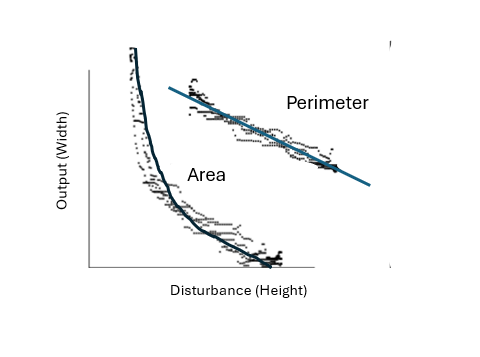
If you choose to control a perceptoin of the Perimeter of the sensory image then you get a linear feedback function and if you choose to control a perceptionof the Area of the same image you get a non-linear feedback function, as shown in the graph below.


These data were obtained by me in two different runs of the “What is Size” demo. The feedback functions for Perimeter and Area are actually the inverses of the Disturbance-Output relationships that are plotted, as per this equation from Powers (1978,p 425)
Capture2,
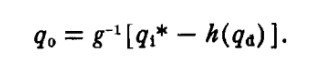
where q.o is Output, q.d is the Disturbance, q.i* is the reference value of the controlled perception (Perimeter or Area) and g^-1 is the inverse of the feedback function. In both cases the inverses have the same form as the Disturbance-Output relationships shown in the graph: the feedback function for control of Perimeter is linear and the feedback function for control of Area is a reciprocal.

The feedback functions for control of Perimeter and Area are different because the PERCEPTIONS controlled (Perimeter and Area) are different.

The same thing happens in conflicts between and within individuals. The position of the flag in a tug of war is NOT controlled. Your position between two attractive alternatives is NOT controlled. In both cases the variable in conflict, VC, can appear to be kept at a virtual reference level (see BCP, index). This happens when the disturbance to VC is large enough (pushes VC outsides the Dead Zone- but that’s another story). I don’t remember seeing Bill’s demo that you describe but it sounds like that is what he was demonstrating. He wasn’t demonstrating control via conflict; he was demonstrating virtual control – it looks like real control of VC because of the apparent disturbance resistance. But it’s not real, it’s virtual!

The CV is a perceptoin and, thus, not in the environment outside the “skin” of the organism. But, as I have shown above in the “What is Size” demo, it IS most DEFINITELY part of the feedback function. And, of course, it can be objectively determined by some version of the Test for the CV. I think you have been confused by the fact that we often call the feedback function the “environmental” feedback function. And the connection to the basis of the CV is in the environment; in the “What is Size” demo the mouse definitely affects the rectangular lines on the screen. But in order to determine the feedback funcition you have to know what perceptual aspect (function) of those lines are being controlled.

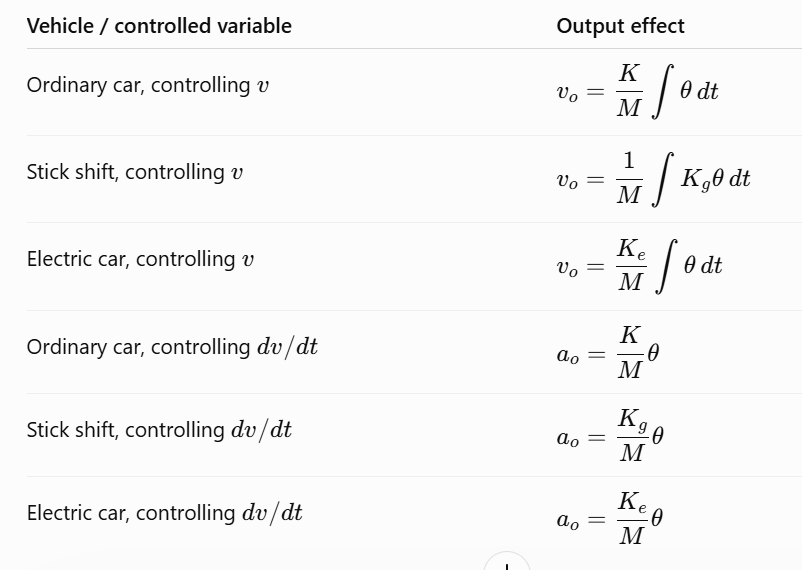
This works only if you determine the nature of all components of the feedback path, which includes system output AND the controlled perceptual variable. This was illustrated in the table (shown below) that showed the different feedback functions for the path from output (accelerator position, theta) to CV (speed, v.o or acceleration, a.o).

Take a good look at this table becuase it can really teach you something about the relationship between your “feedback paths” and feeedback functions.

The part of the table that shows the different feedback paths (by your defintion - everything between output and CV) are characteritics of different types of cars – Ordinary car (gas powered with automatic trans), Stick Shift car or Electric car. But the feedback functions for these different cars are different depending on the perceptual variable being controlled – speed, v.o, or acceleration, a.o (yes, a.o and v.o are different perceptions of wheel rotation). This is the difference we are seeing in the “What is Size” demo when we see different feedback functions for the different controlled variables, Aera vs Perimeter. The objectively observable controlled perceptual variable is an essential component of the empirical feedback function!!

This is a very good description of the controlling done by the Delta customer! Though I would see the different queries as different values or states of the customer’s output. The feedback function runs from the inquiry through the customer service agent to the percption of the answer the customer gets.

Yes, but you could get a qualitative representatoin of some aspects of it, such as the time it takes (on average) for an operator to answer each of the different possible inquiries.

No, I offered it as a nice example of how a rather simple PCT model can account for the observed data. And the basis of the model was control of imitation. I think your reasons for not liking it are fine but what would have been nice is if you had challenged the result with some other data.

Hi Luk

Having spent nearly the entire day answering Bruce, I just have one word for you: HIERARCHY (I was going to say “PLASTICS” but you are probably too young to have gotten it;-)

In PCT, a car doesn’t crash into things in front of it when the driver is controlling for speed because the reference for speed is set by a higher level system in the driver (or the new cruise control system) that is controlling for distance from cars in front.

I have a nice (though fairly abstract) demonstration of how a PCT hierarchy works. It’s a three level hierarchy with six control systems at each level with the systems at each level controlling a different TYPE of perceptual variable. It all works rather beautifullly and, to paraphrase the extraordinary Mae West, feedback functions had nothing to do with it;-)

Best, Rick

Well, to control your perceptions of what you are typing

Right, they are just part of the feedback function.

I thought you were using it to control what you saw on the screen.What happened?

I have no idea what you are talking about. And please stop using that ugly word! It’s a desecration to PCT, both phoneticaly and semantically!

But you did remind me that I have a demo that is somewhat like the situation you describe. It’s my famous “Levels of Conrol” demo which is a tracking task where the polarity of the feedback function reverses (right -left mouse movement that moved the mouse right - left suddenly changes so that right - left mouse movement produces left - right cursor movement). The demo was built to reveal a second level of control taking some time to “kick in” and during that time (about 500 msec) the lower level system just keeps doing its thing, as predicted by the model.

The feedback polarity reversal in this demo is like waking up to a Dvorak keyboard instead of your regular QUERTY. If you are skilled at both then your behavior will be much like that in this Levels of Control demo, although the switch to the Dvorak may take more than 500 msec since this is probably happening at a higher level of the hierarchy than controlling the distance between cursor and target. This is something that might be worth studying, if for no other reason than getting you guys off this mishuga “feedback path” stuff.

Hi Rick,

Got it: The Graduate. In that film, one word handed to a young man as the answer to his whole future is the punchline precisely because it answers nothing. Youth had nothing to do with it.

That isn’t an answer to my question. I didn’t ask about collisions. I asked where the zero comes from in the model: why the pedal stops moving the car when other drivers have taken up the road’s entire capacity. A car standing in gridlock won’t crash into anything. It simply isn’t going anywhere.

Hierarchy doesn’t settle this. A higher level can change the speed reference, but it can’t give the pedal back its effect on speed. Other people took that effect away by using a shared segment of the environment. And your higher level, to work at all, has to perceive the distance to the car ahead, which is the occupancy of the shared road by other drivers. So your answer brings the state of the shared segment into the model. That is exactly what Bruce has been asking for since the start of this thread.

Doorway, stadium, pipe, market. None of these has a car ahead, or a distance loop that makes the problem go away. Your answer doesn’t address them. I’m asking for one that does.

Mae West. I get the joke, but the claim under it doesn’t survive a comparison with Powers. There is no loop without a feedback function. In the hierarchy, a higher level acts only through the references of lower ones, so its feedback function consists of the lower loops plus the environment. A few hours earlier, in #136, you were telling Bruce that even the controlled perception is part of the feedback function. This morning, feedback functions “had nothing to do with” how the hierarchy works. One of those statements has to go.

Your demo. One organism, an abstract and fixed environment, no other agents, no shared capacity limit. A model built without a shared environment can’t show that a shared environment doesn’t matter. It can only leave it out.

You’ve already agreed three times. In #102, g(o) can be any function. In #104, M = f(q_oB). In #109, when feedback-function variations become extreme enough, control is lost. I claim nothing beyond that. The only difference between us is that I name it.

So the question, this time without cars: where in your model does the zero effect of effort come from, when others have used up the capacity of a shared means of control?

Best,

Luk

The car doesn’t crash because the higher level system controlling for the distance between cars sets the reference for the lower level speed control system to zero.

Actually, a two level hierarchy settles it rather elegantly. The higher level system doen’t have to give the pedal back its effect on speed; the pedal never lost it. The higher level distance control system just has to move the speed control systems reference signal to zero. If you are a reasonably good driver your distance control system will gradually reduce the reference of the speed control system to zero as you approach the gridlock.

This is an incorrect mapping of PCT to the situation you describe. Other people (in their cars) did not take away the effect of the pedal on speed; The other people (and their cars) are not part of the feedback connection between pedal and speed. They are a disturbance to your perception of going down the road, which is a third level of control above systems controlling distance and speed.

In PCT, what you call the “state of the"shared segment” – the amount of traffic on the road – is a disturbance, not a segment of a feedback function. A feedback function (or path) is a causal connection between system output and CV; a disturbance is a cause of variation in a CV that is independent of the system’s output. The car’s engine is part of the feedback function because it mediates a causel connection between pedal and speed; traffic is a disturbance because its state is independent of anything the system can do. If Bruce thinks gridlock traffic is a segment of a feedback function then that explains why I am having these arguments with him (and you;-)

The controlled perception is definitely part of the feedback function. Feedback functions had nothing to do with how the hierachy works because they were all the same and had nothing to do with how the hierarchy was able to sucessfully control a hierarchical arrangement of 18 different perceptual functions of the same six environmental variables at the same time.

Actually, all 18 control systems share the same environment of six variables.

Great. Then we’re all agreed.

PCT doesn’t control output, it controls input. So there is no deterministic way to set system output to zero. Output just varies as necessary to get the input to the reference: CONTROL OF PERCEPTON. But there are perceptual variables, like speed, that move the output (pedal position, say) to what could be called the 0 position since that’s the position that brings the speed to 0. But that’s only true on a flat road; if you’re driving in San Francisco – where I left my heart – you will often find that the only way to stop is to go, especially if you are driving a stick shift;-)

But the ultimate output of human control systems (that involve movement) are variations in muscle tension, which can be perceived and that perception can be set to what might be experienced as 0 tension. Just control for letting your arms go limp, say. But, in fact, there is always some muscle tension – called tonus – so muscular output is never really 0 (when you are alive).

So I finally realized that you are asking the wrong question when you ask how does PCT set system output to zero because it imples that you think PCT control systems control by setting output. That’s probably why you thought my hierarchy didn’t work. And it didn’t work the way you want because it doesn’t set the output to zero; it sets the perception (of speed) to zero, which does not necessarily drive system output to zero, as is the case when you are trying to stop at the top of a SF hill. The hierarchy doesn’t work by setting the output; it works by controlling input. And that’s what keeps you from crashing into traffic, in flat Minnesota or hilly SF!

By the way, could you or Bruce or some other expert in this field give me a short (three sentence max) explanation of the role of feedback paths in “collective control”. I know you probably have told me 100 times already but I’m old and forgetful and I think a nice, succinct explanation would help.

Thanks

Best, Rick