I had a bit of a record-scratch moment reading the slides of @tom.cochrane 's conference talk just now:
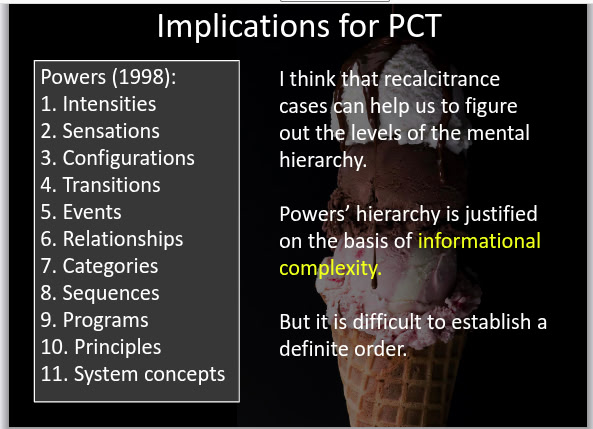
Powers’ hierarchy is justified on the basis of informational complexity. But it is difficult to establish a definite order.
Is this true?
I don’t remember mention of informational complexity on Powers’ accounts of the levels…looking in B:CP, or in his long email on the topic in Control Loop Vol 2 No.2 (PCT Resources)
The general principle is that when you have found a level, like sensation, the next level is going to depend on it; also, the current level depends on the one below it. If you analyze a perception to see what it is made of, at first you see just more perceptions of the same level—big configurations are made of little configurations. But when you analyze in just the right way, you suddenly realize that all configurations, of whatever size or kind, are made of sensations, which are not configurations of any kind. And you realize that if it weren’t for the presence of those sensations, there couldn’t be any configuration to see: a field consisting of a single sensation, such as white, can’t lead to any sense of configuration. There’s a relationship between these levels of perception. That gives us a hint about building models of perception, a hint about how the brain’s perceptual system is constructed.
I don’t know much about the relationship between control theory and information theory - other than being vaguely aware it’s been a fraught one since the early days of cybernetics! But examining this claim might be a place to start.
