···
From: Richard Marken [mailto:rsmarken@gmail.com]
Sent: Monday, May 15, 2017 9:29 PM
To: csgnet@lists.illinois.edu
Cc: Richard Marken
Subject: Why PCT: The Rube Goldberg Justification
[From Rick Marken (2017.05.15.1230)]
RM: Two recent events have led me to realize how important it is, when “promulgating” PCT, to make it clear why PCT was developed: PCT was developed to explain the phenomenon of control as it is seen in the behavior of living systems.
Bill P. at all (50th Anniversary, 2011) :
Perceptual Control Theory (PCT) provides a general theory of functioning for organisms. At the core concept of the theory is the observation that living things control perceived environment by means of their behavior. Consequently, the phenomen of control takes center stage in PCT, with observable behavior playing an important but supporting role.
HB : To be excact it is not only the phenomenon of control that is seen in »Behavior of living systems« but how living things control perceived environment and of course how they function. Control theory is trying to explain why and how orgsnisms behave but it’s priority is to explain how they function. But as I wrote many times before PCT is not finnished yet. It’s a lot of work to be done, so that it will become recognized as leading theory on the field of psychology and medicine.
RM : It was not developed to explain the behavior of living systems, where “behavior” refers to what a system is seen to be “doing” – its observable outputs.
HB : You are all the time promoting what a system is seen to be “doing” – its observable outputs, which by your oppinion.are control what is missing the point as the behavior on stimulu is missing the point.Although you are not pointed out this here.Your writings are all the time circling arround behavior, obervation of behavior and so on
¦.
PCT is trying to understand how organisms function as control systems and how they produce behavior. It’s not that »obervable outpus are controlled«or produced by stimuli as the central problem. Important are internal processes of living systems which are control.
The behavior is not the main point in PCT. It’s important. It’s the part that is opposing classical psychology and this is one of the places where Scott Alexander was wrong. PCT is much stronger theory if you try to understand how living beings function than just to understand how you drive a car r how you observe behavior as control.  And as I could see Scott is not some expert in physiology like you are not Rick. »Blind« will criticize »blind«. What a combination ?
RM : The two events that led me to this realization were 1) re-reading the review of “Behavior: The Control of Perception” by Scott Alexander at his blog (https://slatestarcodex.com/2017/03/06/book-review-behavior-the-control-of-perception/) and 2) discussing the process of mitosis with my a biologist sister-in-law.
HB : Well I answered you on that too. See bellow. You will see that you are inventing »hot-water«.Bill from the beggining realized that »control« is in essence of organisms functioning. And the organism consists of 100 bilion cells. So the essense of cell fucntioning is the essence of organisms functioning
Bill P: (B:CP)Â Â
PCT
«can exxplain a fundamental aspect of how every living thing works, form the tiniest amoeba to the being who is reading these words.«Â
RM: Scott Alexander’s review of B:CP was actually reasonably positive. But one part of that review, in particular, led me to realize the importance of making it clear that PCT is an explanation of control and not “behavior” as conventionally understood.
BH : Behavior has something to do with control but not as much as you think. See above the Anniversary.
RM : It was the part of the review that says “…PCT can predict some things but not much better than competing theories”. This is true only when the behaviors being predicted are produced in a disturbance-free environment. That is, PCT is “just another theory of behavior” when one ignores the fact that the behavior of living organisms is normally produced in a disturbance-prone environment; behaviors that appear to be emitted output are actually controlled consequences of output – they are controlled inputs.
HB : Behavior is consequence of organisms control. Behavior do not »carry« any control. You must be sure what you are talking about. There isn’t any controlled consequences of output. Behavior is consequence of control. See Bills’ physiological evidences in B:CP and diagram in LCS III…
RM : When this fact is taken into account then PCT turns out to be the only theory that can explain the behavior (controlling) of living systems (as demonstrated in Bourbon and Powers (1999) Models and their Worlds, International Journal of Human-Computer Studies, 50, 445-461).
HB : As you pointed out Tom Bourbon you should listen to him and you wouldn’t invent »hot water«. Â
Tom B.
We think that the self-replicating molecules, like those in DNA, are control systems, complete with their equivalents of reference signals that specify which âperceptionsâ of molecular shape, or of chemical states, they will sense. On this construal, gense are not “commands” for what we will become, but they are control systems that control for certain molecular states; of the rest that happens is in a way one big side-effect of control at the biochemical level. If that is so, then it must be the case that, more often than not, creatures like us, with perceptual hierarchies like ours, end up being good environments for DNA to achieve its own control.
HB : Listen to him Rick, he seems to be a wise man. PCT behavior (controlling) of living systems is :
Bill P :
It means that we produce actions that alter the world of perception, and that we do that specifically to make the state of that world conform to the reference conditions we ourselves have choosen (to the extent we can change the perceptions by our actions).
Bill P : There is one explanation for the existence of reference states that has been proposed over and over the centuries : they are determined by the intentions of the behaving organism. The driver has, inside him, the intention that the door be open. He acts to achieve this purpose, doing whatever is required (if possible) to achieve it
HB : Control is happening in organism and the behaviors are jsut means to support control in organism.
RM: The discussion of mitosis – one type of cell division behavior-- also shows the importance of understanding that PCT is an explanation of control.
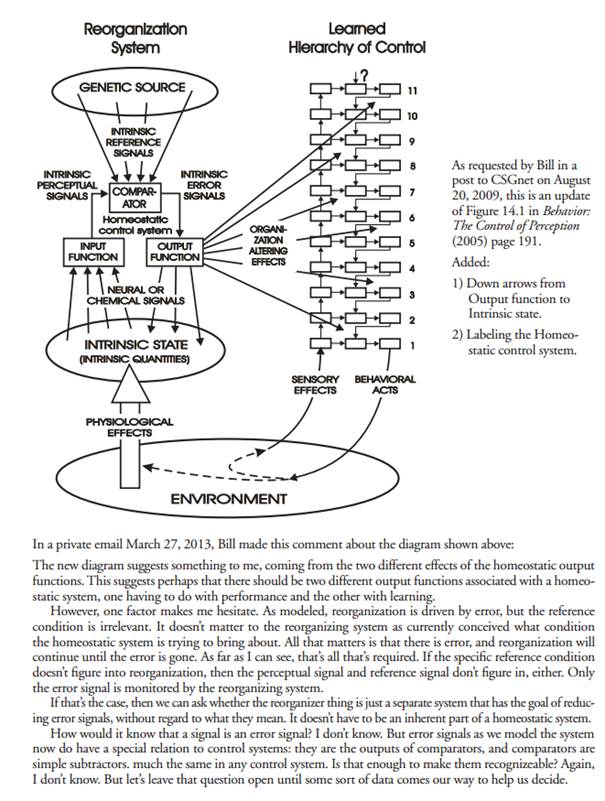
HB : Vauuu. What a discovery. In his diagram p. 191 (B:CP) Bill is clearly determining the control of Living beings with »genetic control system« that is the driving power of organisms control. Although he didn’t exactly talk about »genetic control system (Tom Bourbon did), it is obvious that he meant just that.
![cid:image002.jpg@01D2A19D.2EFD1100]()
I’m sure that Bill was acquainted with some medicine knowledge (he seems to be employed in hospital and he has a friend physiologist). So I don’t doubt that he knew that in physiological books you could find »genetic control« in cells at least from arround 1956.
So you are out of time Rick. Bill already defined that organisms function on the basis of »genetic control«. We can conclude that from diagram on p. 191. It’s clear that references come from genetic source. And as PCT is about control units in organism it’s not difficult to conclude that he is talking about »genetic control unit«.
Genes (DNA) controls the forming of organism including cell divission »mitosis« (Eucarionts) … Genes control also other type of cell divission (for example bacteria), but it’s different from »mitosis«. »Binary fission« can be explained only with »genetic control«.
So the point is that we have to finnish diagram on p. 191 (B:CP) what I’m proposing for a long time, so that you Rick will not invent »hot-water« all the time with your theory RCT.
RM : Mitosis involves a complex sequence of steps where the start of each step depends on the successful accomplishment of the previous step. My biologist sister-in-law was convinced that the process of mitosis was completely explained by the laws of physics and chemistry; no control involved at all. But it seemed to me that consistently carrying out this process successfully implied that some kind of control involved since the process is being carried out in a disturbance-prone environment.
HB : Well unwillingly I have to agree with you. But if you would be acquanted with physiology you wouldn’t blindly guess, because you would know that in the basiscs of cell regulation is for along time know »genetic control«. O.K. I’ll repeat again that Bill showed this »fact« on p. 191 (B:CP) and probably in his other literature.
RM : One step, in particular, caught my attention; the process of “centering the centrosome”. Apparently the centrosome has to be accurately maintained in the center of the cell before the next step in the process can proceed. The biological explanation of this centering is a causal model that involves building filaments that exert equal force at different points around the centrosome. But I realized that this process was carried out in a cell that was likely to be varying in shape somewhat over time. So the centering of the centrosome had to be a control process. This idea was firmly rejected by my sister-in-law. And I realized that this is because she (and, apparently, most biologists) saw the process of producing cell division behavior (mitosis) in the same way psychologists see the process of producing overt behaviors (like walking) – as a cause-effect process where a complex sequence of effects (results) are produced with each result, once produced, becoming the cause of the process that produces the next result. I will call this the Rube Goldberg view of behavior.
HB : You could conclude that from diagram on p. 191 (B:CP) if you would understand it of course. It’s true that diagram needs upgrade, but the main point of »genetic control« in organisms is done. I even think that with improved version of diagram on p. 191 (B:CP) we could make simulation of cell division from the view of »genetic control«. I think that’s what PCT is about. To show how cotnrol works in organism from genes to 11.level of hierarchy.
RM: The Rube Goldberg view of behavior sees a complex behavior like cell division as the activity of a Rube Goldberg machine. A Rube Goldberg machine is a “deliberately complex contraption in which a series of devices that perform simple tasks are linked together to produce a domino effect in which activating one device triggers the next device in the sequence”. The end result of this complex process is some ridiculously simple achievement. But for present purposes what’s interesting about these devices is that the end result will not be achieved unless each of the intermediate steps in the process is carried out successfully. Rube Goldberg was a cartoonist and his amusing devices always worked on paper (just like the causal models of mitosis always work on paper). But when you actually try to build a Rube Goldberg machine that works in the real work, you discover that getting it to produce the end result reliably is a virtual impossibility. This is because, in the real world, there is many a slip 'twixt cup and lip because there are disturbances that can disrupt the process at each step. Here is a video of a real-world Rube Goldberg machine in action:
https://www.youtube.com/watch?v=YWk9N92-wvg#t=27
RM: This video shows the Rube Goldberg machine achieving its end result: rolling out the new Honda. It succeeds because, as you can see, each of the complex steps in the process is carried out successfully. So it looks like a complex set of causal links can produce a particular end result. But it turns out that this machine made it through all steps successfully only after 606 failures! On 606 prior “takes” something went wrong at some point in the process, so the machine didn’t manage to produce the end result until take number 607, when, apparently, by luck disturbances failed to interfere with the production of the correct results at each step in the process.
RM: Clearly, this Rube Goldberg process – a series of complex causal steps – cannot be what is going on in mitosis (or other biological of behavioral processes). The end result of mitosis – cell division with the correct compliment of chromosomes in both daughter cells – is achieved nearly 100% of the time; the end result of the Rube Goldberg machine in the video is produced, at best, .16% of the time. This seems like pretty strong evidence that mitosis is not a Rube Goldberg process; the steps in the process of cell division may look like the steps in a Rube Goldberg (causal) process but the fact that the end result (two perfect daughter cells) is produced with nearly perfect reliability in what is known to be a disturbance-prone environment suggests that what we are looking at when we look at mitosis is control. A model that correctly accounts for the behavior of cell division (like a model that correctly accounts for any consistently produced behavior of organisms) will be a model of control – PCT.
HB : Well at least I know this from year 2007 when I think I read »Behavior : Control of Perception«. But it’s good to discover it once in time than never.
RM: The idea that PCT is a model of control and not of behavior as conventionally understood – the behavior of a Rube Goldberg machine – is one that is very hard to get across.
HB : So far so good
J. But it’s not that hard to get across of control in organism if you understand what you are reading in B:CP. Then it’s very easy.
RM : But I think it is at the heart of the problems PCT has had with becoming accepted in the behavioral and other life sciences. But I want to try to get this idea across to behavioral and life scientists and I think maybe I can do it using the idea of a Rube Goldberg machine as an example of a device that produces the kind of behavior that does not involve control – and, therefore, can’t work reliably in the disturbance prone real world. I’d like to do this in the context of criticisms of PCT, like those in Scott Anderson’s review of B:CP. So I would appreciate it if anyone could point me to other articles where PCT has been criticized. Again, I think all the criticisms of PCT that I have seen (and I’m doing this from memory) are based on the mistaken assumption that PCT is an explanation of behavior as caused output (as is that of the Rube Goldberg machine) rather than what it actually is: an explanation of behavior as control.
HB : Well you were doing so good and on the end you »bullshitted« everything. It’s not behavior that is controlled, it’s perception. So if you’ll continue criticizing non-PCT articles, don’t do it with non-PCT theory like RCT is. If you’ll do it, I’ll have to cirticize you.
Bill P :
The flaw of this reasoning is hard to understand if one does not know (as the founders of scientific psychology did not know) of organizations capable of complex internal activities that are essentially independent of current external events. By ruling out the possibility of significant causes of behavior inside the organism, where they could not be observed, early behavioral scientist in effect commited themselves to a whole chain of deductions following from the assumption that everything of significance with regard to behavior could be observed from outside of organism. They were betting everything on the assumption that such internal causes would never be found to exist.
HB : I’ll just repeat again that PCT organism on p. 191 is showing quite well how internal functioning of organisms start in »genetic control« which is known in physiology for a long time. I’m not acquainted with the state in biology, but it seems to be behind PCT and physiology for at least 60 years.
So I’ll again offer the possibility that Powers ladies could organize proffessional project on improving diagram on p. 191 (B:CP) so that members will not have problems understading that PCT is how control function in organisms from the core of its existance. .
                                    Â
HB : So we see that Bill beleived that PCT can explain also how cells function as control system. And the diagram on p. 191 is showing also that.
Best,
Boris
Best
Rick
–
Richard S. Marken
"Perfection is achieved not when you have nothing more to add, but when you
have nothing left to take away.â?
–Antoine de Saint-Exupery