* Diagram Police *

Right. So the value of QoC can’t possibly be affected by the correlation between P and the corresponding variable in Real Reality because QoC measures only a person’s ability to control what you correctly describe as a “perceptual reality of an experimenter that the experimenter chooses to measure”. In PCT, that perceptual reality is called qi. When the QoC of qi is poor, the reaction is different depending on whether the experimenter is a “man-machine” or a PCT control theorist.

The man-machine control theorist sees poor QoC as evidence that a person needs training to improve their performance; qi is seen as a variable in the real world – such as the position of a car in its lane – that must be controlled well in order to accomplish a task – such as safe driving.

The PCT control theorist sees poor QoC as evidence that the experimenter’s definition of the variable an organism is controlling, qi, needs to be improved; this is what the test for the controlled variable is all about.

There is nothing wrong with being a man-machine control theorist. What is “wrong” is when a man-machine control theorist thinks he or she is a PCT control theorist.

Best, Rick

I don’t know. You are right in this - if the variable you actively disturb stays stable from the perspective of the subject, then yes, this means you found a good approximation for the controlled variable. But why invoke the Real Reality at all? I don’t think there is any reason to bring it up, since we can’t measure anything from it, know anything about it, and really can’t say much about it at all. You can believe there is something happening in the Real Reality, but if you can’t confirm it by experiment, then that belief is outside of the scope of science.

if you measure good quality of control, there is reason to believe that the subject will resist different types of disturbances to maintain the variable stable. So you can predict some behaviors and verify experimentally whether they really happen - still in the perceptual reality of researchers, though. You can also try to find correlates of predicted variables in the brain, in some neural signals. Again, nothing about Real Reality there.

Newton was quite famous for his ‘non fingo’, which I suppose meant he didn’t want to speculate about the Real nature of gravity. He had a mathematical law that agreed with observations, and that’s that. You can believe there is an angel pulling Earth, or that there is a curved space-time phenomenon in the background, the law still stands as it is, and predicts as well as before. Einstein found a more precise law, it predicts better, but again, it doesn’t say much about what Really happens. Space-time is an abstract mathematical object.

Diagrams of control systems are just visual counterparts of mathematical expressions describing control systems, and just like the expressions, only relate some measurable quantities to other measurable quantities.

Adam,

I’m not clear what you are really objecting to. Here are a few hypotheses:

  1. You think it unscientific to say anything about Real Reality? I strongly disagree.
  2. You think it unscientific to say what Real Reality consists of? I strongly agree.
  3. You are uninterested in whether anything scientific can be said about Real Reality? I have no comment.

And other possibilities that I could not figure out how to include in continuations of this formatted list…

Here you seem to be saying that the experimenter’s perception is real, but the subject’s is not. Bill P always said that to everyone the only “real” thing was their own perception. The implication I get from this quote is that you believe in solipsism, and for the experimenter I imagine that you are imagining, recursively that experimenter is “really” imagining that some experiment was “really” run and had this “real” result. But I find it hard to believe that this was your intention.

That’s a good paraphrase, nearly a quote, of what I said, so Yes. But what do you mean by “what Really happens”? Incidentally, the twoness of cows in a field is also an abstract mathematical object. So what?

I disagree that all the quantities in a diagram are or should be measurable. Consider a control diagram drawn before there was any technology to tap into nerve firings. Would such a diagram, featuring the abstract concept of neural currents, not be a diagram of a control system?

To repeat what I said above, I don’t know what it is that you object to, especially when you devote most of a paragraph to essentially quoting half of one of my paragraphs in the message to which you object.

Precisely, but what you cannot be a scientist and believe is that apples falling from a tree wait around until you watch them before the fall correctly, according to the inverse square law. Likewise what you can believe only if you are a thoroughgoing solipsist is that your muscular actions in a tracking task do not affect anything in Real Reality, and that what affects changes in your sensors that leads to your perceptions does not come from Real Reality. What affects your sensors cannot not both come from and return to only your Perceptual Reality.

If PCT is to have any relation to what happens around a control loop, Rick’s long-standing assertion that your perception IS your perceptual reality must be correct. The source of the perception must be elsewhere, and that elsewhere affects the sensors.

Well, I suppose the issue started with this sentence

I claim that you cannot represent anything from the real reality in a control diagram, and I find your claim above contradictory to your other claim that we shall never know what Real Reality is (which I agree with).

For example, you say that a Real environment affects rods and cones. This creates some neural signals. When we express this claim as a mathematical function or an equivalent diagram, we have measurable quantities on both sides - light wavelength and intensity on one side, and spike count on the other. And the problem I have with this is that wavelengths and intensities are not the Real Reality. They are abstract models that help us explain our observations (experiences), and have equal metaphysical status as neural quantities (also abstract models).

To say the same thing in a different way: diagrams don’t show a split between a real reality and a perceived reality. The environment-organism line merely divides variables with different measurement units, and perhaps follows the ‘skin’ limit of the organism.

I’m saying that my experience is real to me. I know my experience is only a “perceptual reality”, and I can believe there is a Real Reality it depends on, but that is about all I can say about Real Reality. It exists as a foundation for my perceptual reality, but is just my unprovable belief.

Also, I can’t say much about the subject’s experience. I can believe it is there, or not there, but I can’t prove it either way. On the other hand, I can readily measure quantities inside our outside of his skin, compare them with my models, etc. I don’t need to have any particular stance toward Real Reality to successfully perform behavioral experiments.

I mean that abstract mathematical objects are still parts of our experience, the perceived reality, and not the Real Reality.
And to come back to the point, diagrams or other mathematical laws are trying to relate different variables in people’s observations.

Ok, I agree. I suppose all variables don’t need to be measurable. For example. there could be some quantities that are just mathematically convenient to be expressed as separate in a formula or a diagram as but when we measure them in an experiment, we measure a single variable as a function of multiple variables.

This time I’ll be short and simply ask what you mean by “thing” as in “anything from the real reality”.

Perhaps this question can be made more precise, as in do you distinguish between “object” and “operation” as examples of “things”. My claim is that it is possible to study operations performed by whatever unknowable objects may exist in real reality.

It’s like not knowing what “objects” are in a smart phone, but discovering that by hitting a button whatever those objects are, they perform operations that allow me to seen patterns on the screen that I can interpret.

I have no idea (though I can make a good guess) whether lots of little gremlins are inside the phone noticing that certain spots on the screen have been touched and telling their comrades to produce thus-and-so effects, such as to produce my wife’s voice when I was silly enough to assume she simply did the process I would call “answering her phone”.

“Things” are definitely parts of our experience, but I do assume there is a reality independent of my experience. I cannot prove that solipsism is false, so I just take it as an axiom that there is an independent external reality. “Operations” are functions or laws we use to explain what is going on between some measured “things”. So, yes, we can study the operations performed by the external reality.

I think we are really in agreement, despite having seemed to be opposed.

Perhaps the thread can return to its topic about diagrams, which I think of as a means of communication on a par with verbal communication, best made as simply as possible for the purpose, but as ?Einstein said, no simpler. The measure of complication needed for effective communication in words, gestures, or diagrams depends on the prior belief structure of the intended target interpreter.

Dear Adam et al.
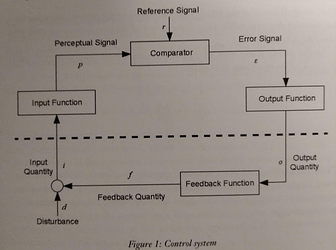
As editors of a new handbook on PCT, we want to reproduce a basic control unit diagram that ideally:

  • is accurate with respect to PCT as described by Powers
  • is largely agreed upon by contemporary researchers in PCT
  • is interpretable by people new to PCT
  • is interpretable by other scientists, engineers and mathematicians
    Phil Farrell, one of the authors for the handbook has kindly spelled out the logic for some modifications and clarifications if the diagram by Bill we have been discussing on Discourse.
    We’d appreciate any feedback or suggestions. These could include the suggestions made before such as whether a disturbance function should be included.
    Kind Regards,
    Warren, Eva, Vyv & Tom

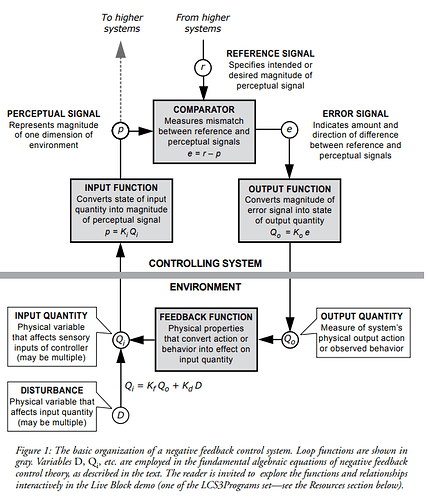
I think you can’t go wrong with something like this, from LCSIII, p. 175, the mathematical appendix by Richard Kennaway:
image

The diagram has consistent notation inside and outside the loop, it is fairly generic and abstract and could be made to fit different equations, like input function with or without a delay, or disturbance and feedback quantity adding or subtracting to form the input quantity, etc. Should be understandable to engineers and mathematicians.

For a bit more descriptive approach for general audience, maybe use Richard’s diagram and add the descriptions from this diagram, but without the explicit equations (so it can remain abstract), no little circles around variables. The variable Qi should not be in the adder circle, but next to the ‘arrow’ entering the input function.

image

For the disturbance function, it might be important for a discussion of the test for the controlled variable, maybe not in the general control loop diagram.

1 Like

I agree. Both of those are useful - and “official.”

Hi folks,
Thanks for the invite to this discussion. I just had the opportunity to respond to Vyv’s remarks on slight modifications to Figure 1 above that I provided probably last summer, which has better alignment with both Powers (1973) description of an ECU and a standard Control Theory feedback loop.

First, the word “Variable” in “Complex Environmental Variable” is mathematically not an appropriate term. Rather the Complex Environmental Variable(s) should be a Complex Environmental Function that transforms the output of the Output Function and any disturbances in the world into world/environmental states or state variables or sensory information that can be sensed by the many (visual, audio, tactile, olfactory, and taste) sensors that animate objects may have. At the lowest levels, these state variables become the input variables into the Input Function. I should also mention that Powers (1973) did not explicitly illustrate whether the disturbance variable is an input into the CEV (or more properly CEF) or an input into the Input Function.

When looking at an ECU through the lens of Control Theory, the disturbance variable (D) and the disturbance function (Kd) always precedes the “Plant” or in this case the CEF (Figure 1 refers to this as the Feedback Function).

Second, Control Theory has standard terms for all of the functions and variables around the ECU, which is a standard feedback control loop such as: reference signal, Comparator, error signal, Controller, Plant, disturbance, output signal, and Feedback Function. So for a Control Engineer, like Bill or myself, the PCT Feedback Function in Figure 1 above would be the standard Control Theory “Plant”, and the PCT “Input Function” would be the standard Control Theory “Feedback Function”. As long as the PCT community understands that the terms are being used differently than with the standard Control Theory, then I suppose that’s okay. (See Table 2 of my chapter that compares PCT and Classical Control Theory terminology).

But “Physical properties that convert action or behaviour into effect on input quantity [or world states]” is by definition a Complex Environmental Function and not a Feedback Function. So this, to me, seems to be the most appropriate term.

In sum, I would suggest that “Feedback Function” be replaced with “Complex Environmental Function” and that the disturbance and output quantity become inputs into the “CEF” rather than the disturbance being an input (along with sensory inputs) into the Input Function.

Epilogue: I would not say that having the disturbance as a direct input into the Input Function is incorrect because mathematically one can sense/observe disturbances directly (which actually a case in my book chapter). But in reality all actions/communications first act on the world and are converted into sensory information that an observer can then sense.

Thoughts?

“animate objects” should read “animate or inanimate agents”

Hi Phil, I don’t see Figure 1, could you post it here on Discourse?

PCT concept revised.pdf (440.4 KB)

Sorry Adam, I had meant to upload the suggestion!
Here it is!
Feedback on this please, which is along the lines you are mentioning…

Thanks! Yeah, it looks like we are thinking along similar lines.

The feedback function could be the plant, but it could also be the ‘sensor’ or ‘transducer’, if it is in the feedback path, right?

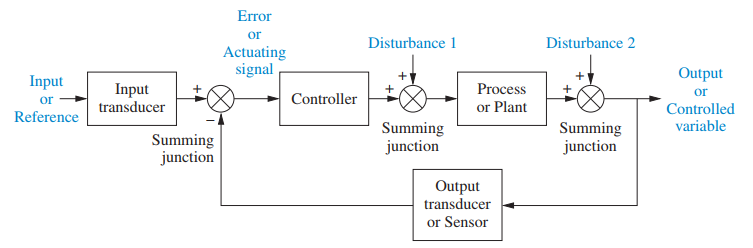
Here is one textbook diagram, (Nise)

I don’t see a problem with putting the disturbance before or after the CEF, disturbances could pop up anywhere. In a tracking task, D1 could be acting on the measuring instrument, like a mouse sensor skipping some lines, or added directly as a random signal, and D2 could be the target position; controlled variable being the distance between cursor and target.

For a bit more abstraction, maybe the formulas like
p = Ki qo and qo = Ko e
could be written as with functions instead of coefficients:
p = Fi(qi) and qo = Fo(e)

Hi Amatic,
Thanks for the standard Control Theory diagram. I agree that one can have disturbances before or after the CEF, however care must be taken to note that these disturbances have different natures. In order to sum D1 and the Controller output variable they must be of the same nature.

For PCT the “Controller output” or the Output Function is a behaviour or action. Therefore D1 is an action such as the action on a measuring instrument or the experimenter inputting a random perturbation to the cursor (or target) position.

For PCT the input into the “Output transducer or Sensor” or the Input Function are world states or information that can be sensed (I call this sensory information). Therefore D2 (i.e., target position) is a state or sensory information - not an action.

An action, D2`, can be transformed into a state, D2, with a function Kp as follows: D2 = Kp D2’.
This is exactly what is suggested in Figure 1 of Mansell (2020).

But what is Kp? Well, Kp is a sub-function within the CEF: that is, it is part of the environment or Plant. Thus, mathematically (and conceptually imho) it makes sense to add all actions / behaviours (Output Function output, D1, and D2’) before the CEF, Kp is part of CEF, and the CEF then produces all world states that may or may not be observed by a low level ECUs.

In sum, one needs to consider the nature of the disturbance to determine whether it should be placed before or after the CEF. If it is an action then it is before. If it is a state then it is after. But a change in state always requires an action. Therefore a disturbance that is a state can always be expressed as an action multiple by an environment sub-function.

On another topic. Note that in Control Theory, the Controlled variable is the output of the Plant but in PCT the controlled variable, the variable being controlled is the perception which is the output (downstream) of the sensory Input Function. This is one subtle but very important difference between CCT and PCT.

food for thought,

Dr. Phil

Yeah, I agree that variables should be of the same nature to be directly added. I find it useful to think about all the quantities as variables with specified units. If the action of the organism is defined as a force in newtons, then the disturbance to the action needs to be a force in newtons too, maybe friction or gravity, or some generated force.

It is a bit tricky to define target position or cursor position as sensory information. From the perspective of the person doing a tracking task, the perceived and controlled variable is the distance between the cursor and the target. Anything that changes the distance is a disturbance to the controlled variable, so the experimenter can affect the controlled variable by changing the target position; if the position of the target is defined in pixels or meters, it can be added to or subtracted from cursor position, also in pixels or meters.

For the other topic, I don’t see the difference. “The output” is not directly plant output, at least according to Nise’s diagram. The controlled variable in control theory is the variable sensed by the sensor (aka transducer). The controlled variable is called “the output” and is downstream of disturbances. Equally, in PCT, the controlled variable is the variable sensed by the sensor (aka input function), it is called the “perceptual controlled variable”, and is downstream of disturbances.

But those are all just naming differences, the math is the same. Or did I misunderstand you?

We could be a bit more strict and say that, really, only the electrical signal representing the controlled variable is maintained equal to the reference. If the sensor is malfunctioning, the electrical signal can still be controlled, without the ‘output’ being controlled. True in organisms as in artificial control systems. If the system is operating normally, both the controlled variable and the signal representing the controlled variable are maintained at the reference level or equal to the reference signal.

Though the important focus of this topic is diagram hygiene, an equally important part worries at a crux of epistemology, the correlation of perceptions with reality.

The reference level is a perception in a control system conducting the test for the controlled variable.* If we accept (or stipulate) that only pre-perceptual variables {v v v} are physically present in the environment, we see that this is necessarily so. Is the level of the intensity perception of one isolated v an exception? The v is in the environment; is the amount of that v in the environment or is it only a perception of the v? I would say it is both, and here is a correlation of perceptions with reality.

[* Or a system for some other reason controlling a perception of the amount that another controller is or should be controlling, e.g. while giving instruction.]

In Bill’s diagram and its heirs the {v v v} are placed together in a circle (as here I use curly braces). This asserts that the perceptual input function associates them in the course of constructing a perception based upon their influence upon intensity receptors. Are we warranted to say that they are associated in Real Reality (RR)? To deny this is to deny the possibility of experiment. Without it, the environment is an unreliable place about which it is not possible to learn to control any but intensity perceptions. Before you cavil, read on, please.

The notion of a complex environmental variable (CEV) asserts that the {v v v} are co-present in the environment, as evidenced by the phenomenon that their several influences are co-presented to intensity receptors.

To assert the existence of, say, the mouse that now rests idle near me as I type, is only to assert that the physical micro-variables {v v v} from which input functions construct that perception are present in the environment and that these variables are reliably and consistently present together in the environment.

Observers only have their own controlled perceptions as a basis for identifying the controlled perception. What Control Theory does is flip the idea of ‘detection’ on its head. Rather than observers presuming that their perceptions represent what the subject is obliged to perceive more or less well, CT observers must perceive the subject’s perceptual relationship to {v v v} in the shared environment and place themselves in a like perceptual relationship. How that is done, and how to indicate that in diagrams, has not got so much attention. Perhaps it should.

Each v is in the environment, and the amount of that v is in the environment. The cooccurrence of the individual variables of {v v v} is in the environment. In these three aspects may be found the correlation of perception with reality. Without this, science is not possible, nor much else of life as we know it.

I think Phil (Hi, Phil!) misunderstands the nature of the CEV in a control loop. It is a variable, not a functions. It is the output of the summing junction where the environmental feedback function is added to the disturbance, not a function itself, though what I called the “summing junction” may be a function more complex than a simple addition, as may also be the comparator in the symmetric position with respect to the reference and perception inputs.

“Variables” are constructs that can be described by numbers, while “functions” are the ways those numbers relate to one another. The inputs and outputs of functions are variables. The CEV is a variable in Perceptual Reality constructed by some hierarchy of perceptual input functions from data derived both from sensory inputs and from imagination. It corresponds to a variable in Real Reality constructed by Real Reality functions that have inputs from the controller’s outputs to the environment and from elsewhere both perceivable and unknowable (effectively random noise).

Real Reality influences the senses, and the perceptual input functions construct all of Perceptual Reality, as a simulacrum of an aspect of Real Reality. We can know or rather, we can approximate, the Real Reality functions, but we can never know by what mechanism those functions are constructed.

We cannot know whether the mouse exists in Real Reality as we see it under our hand, but if we treat it as though it does, it usually functions as we expect it to do, and that’s enough for non-philosophical purposes. For practical purposes, it’s perfectly fine to talk as though what we see, feel, hear, smell, and so forth, like the mouse or dinner on the table, is what we get, even though we may later find out that it was a mirage, a hallucination, or an illusion. In ordinary circumstances, for concrete, tangible, objects it usually isn’t.

The implication is that we can approximate in our perceptual reality the functionality of any aspect of real reality to any level of precision we want. Physics has gone to extreme lengths in this direction, but even physics is clearly incomplete in detail, as are, and always will be, all other sciences, even PCT.

In respect of PCT diagrams, what serves communication best for the purposes of constructor and interpreter is the best diagram. I haven’t seen any yet that represent the entropy dissipation performed by perceptual control, or the relative energy flows involved in solving the problem of dissipating the heat created by the neural firings and other non-adiabatic processes involved. Nor have I seen diagrams that make prominent the important roles of side-effects .

There are many ways to represent the workings of a perceptual control loop, not to mention a hierarchy, depending on what it is you want to make clear, and to whom you want to make it clear. On the other hand, the discussion so far seems to be based on a shared assumption that everyone wants to make the same things clear to the same audience, every member of which has the same intellectual background and controls the same perceptions for which a correct visual understanding of PCT might reduce error.

I think that’s a wrong assumption, and the label of this thread is appropriate. Just as the police we encounter in the world enforce laws that describe overlapping prohibitions and requirements on people’s perceptual control actions, so the proposals in this thread describe what people should do, rather than what they might be trying to achieve.